

Glossary · Sheds & pergolas · Gurgaon & Noida
Polycarbonate sheet: solid, multiwall and the UV layer
Polycarbonate sheet is a clear, very impact-resistant plastic used for terrace sheds, skylights and canopies. It comes as solid sheet, which looks like glass, or multiwall sheet with hollow ribs that insulate better. Outdoors it must have a UV-protected surface facing the sun, or it yellows and turns brittle.

Ask for a "poly shed" in Gurugram and you will be offered polycarbonate, the material behind most see-through terrace covers, balcony canopies and parking roofs. It lets daylight in, stops rain and is light enough to span a steel frame without heavy beams. It also has a reputation for yellowing, cracking and drumming in rain. Almost all of that comes down to which sheet was used and how it was fixed.
What is polycarbonate, and what types are there?
Polycarbonate is a thermoplastic that is many times more impact-resistant than glass, at roughly half its weight for the same thickness. It is extruded into sheets in two main forms:
| Solid (compact) sheet | Multiwall (hollow) sheet | |
|---|---|---|
| Look | Glass-like, clear or tinted | Ribbed, translucent, visible flutes |
| Common thicknesses | Roughly 2–12mm | Roughly 4–16mm and more |
| Light transmission (clear) | High, close to glass | Lower, diffused; about 80% for a clear twinwall is typical |
| Heat insulation | Low | Better, because of trapped air |
| Rain noise | Louder | Quieter |
| Impact strength | Very high | High |
| Best for | Canopies, skylights where clarity matters | Terrace sheds, car-park roofs, large spans |
Corrugated polycarbonate profile sheets, shaped like metal roofing, are a third option for utilitarian roofs. Tints such as bronze, opal or blue cut glare and heat at the cost of some daylight.
Why does the UV side matter so much?
Raw polycarbonate is degraded by ultraviolet light: it yellows, loses clarity and becomes brittle. Good outdoor sheets carry a co-extruded UV-protective layer on one face, usually marked on the protective film. That side must face the sun. Install it upside down and the sheet ages as if it had no protection at all; most makers' warranties against yellowing are void in that case. Our polycarbonate sheet yellowing page shows the result.
How should a polycarbonate roof be fixed?
- Slope: enough fall for water to run off; flat sheets collect dust and pond.
- Flute direction: on multiwall sheet, flutes run down the slope so condensation drains out.
- Sealed ends: the top edge taped with solid tape, the bottom with breathable anti-dust tape, so flutes do not fill with dust and algae.
- Expansion gaps: polycarbonate expands much more than steel, so screw holes are drilled oversize and fitted with sealed washers; tight holes crack.
- Proper profiles: glazing bars or H and U profiles at joints, not just overlapped sheets and silicone.
Where polycarbonate works, and where it doesn't
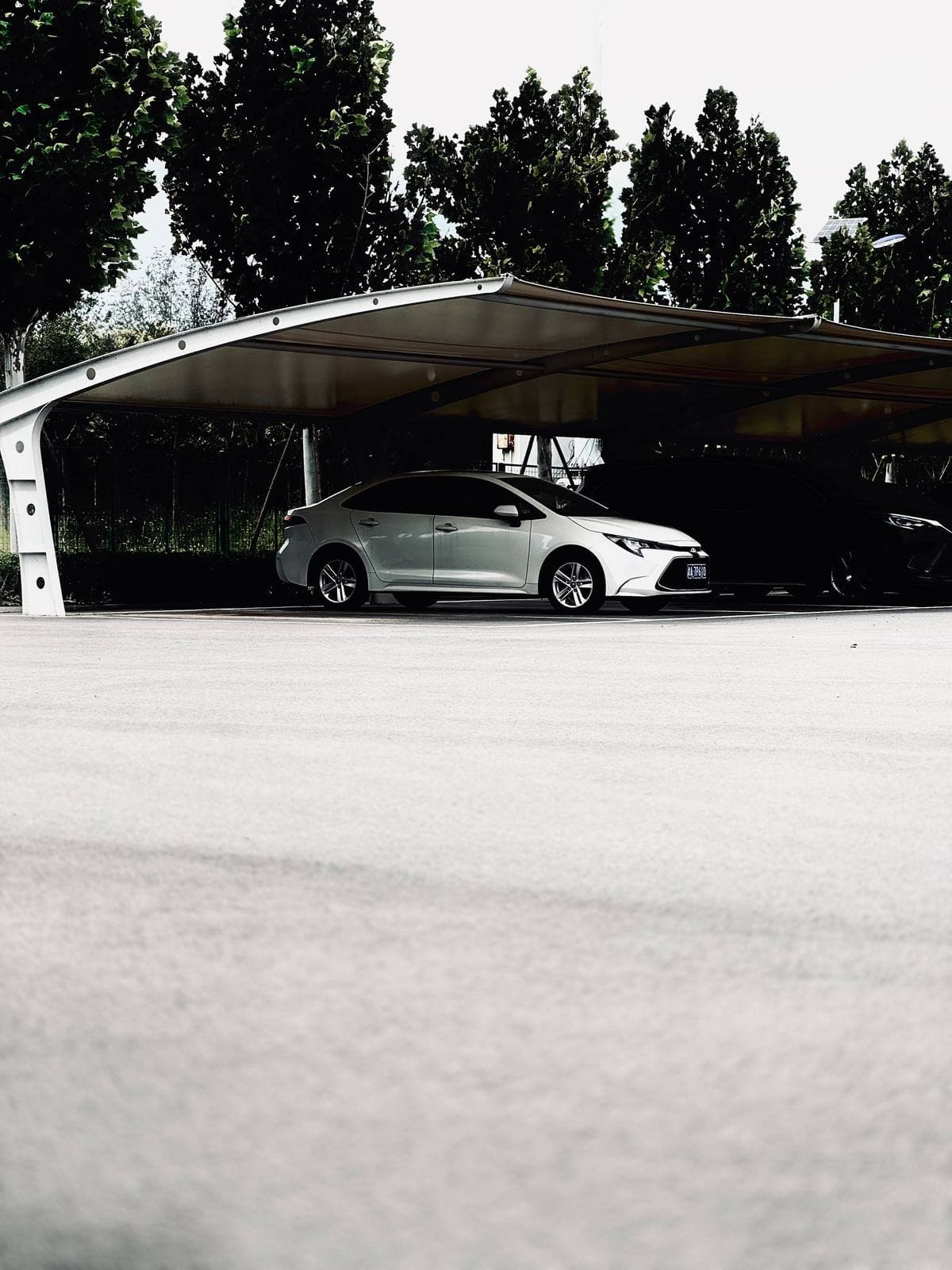
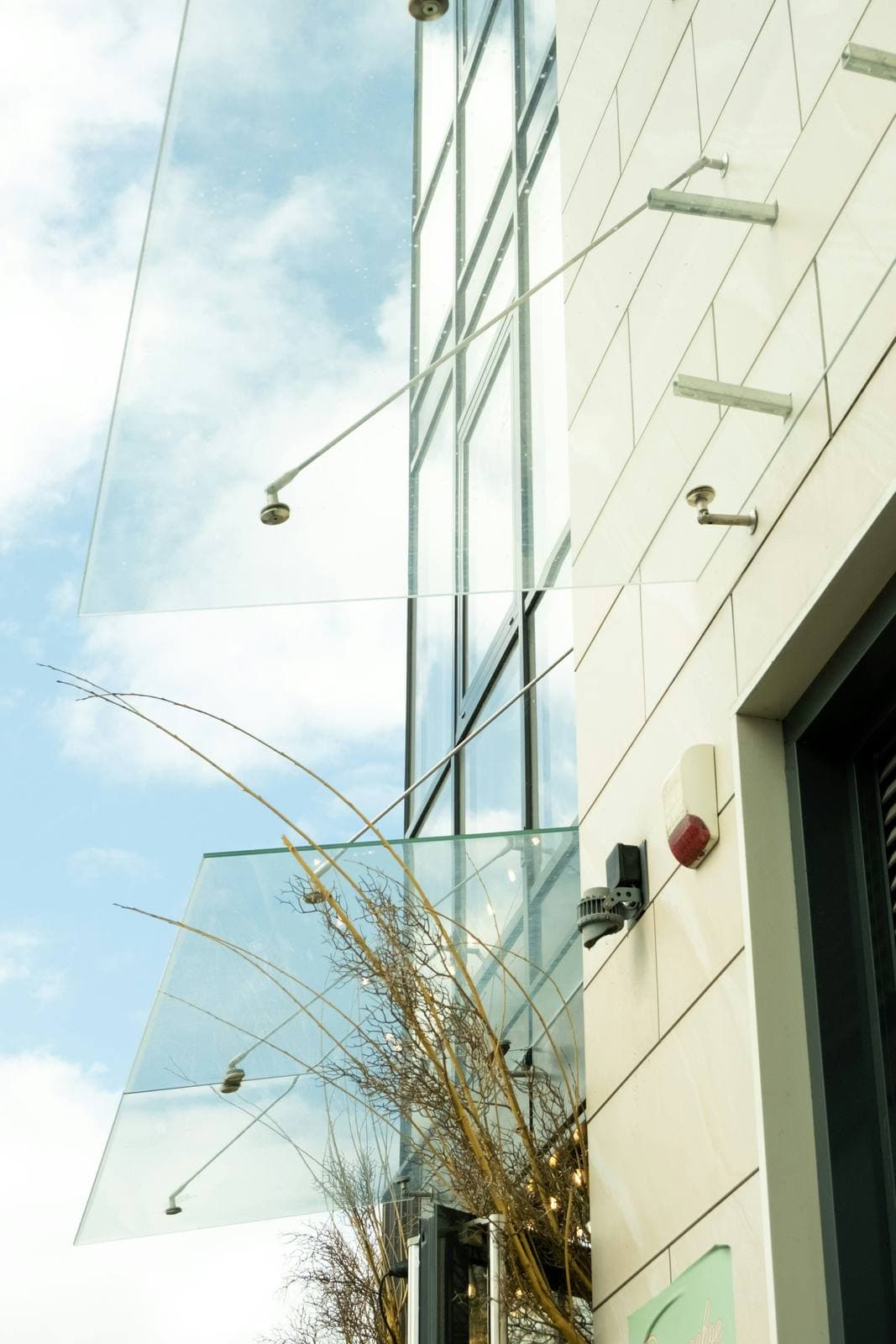
It works well for a polycarbonate terrace shed, a covered drying area, a car parking shed or a light balcony canopy. It is less suitable where a building needs to stay cool under the roof all summer (an insulated metal sheet does better), or where you want a crystal-clear, scratch-free look for decades, where a glass canopy is the premium choice. Our polycarbonate vs metal sheet roof guide lays out that trade-off.
How do you verify the sheet?
- Ask the brand, thickness, type (solid or multiwall) and colour in the quote.
- Check the protective film for the UV marking and the maker's name.
- Weigh a sample if you can: very light sheet for its thickness can mean thin walls.
- Ask about the warranty terms of the sheet maker, which usually require correct orientation.
Common confusions
Polycarbonate is not acrylic: acrylic is clearer and more scratch-resistant but far more brittle. It is also not the same as fibreglass (FRP) sheet, which is cheaper and more opaque. Noise in rain is real with thin solid sheet; see shed noisy in rain. And a cracked sheet is more often a fixing problem than a material one; see polycarbonate sheet cracked.
Care
Wash with lukewarm water and mild soap using a soft cloth. Do not use abrasive powders, solvents or a dry wipe on dusty sheet, which scratches it. Keep gutters and the lower edge clear. Frames and profiles are covered under sheds and pergolas; sheet and framing are specified after the site visit.
Common questions
Which is better for a terrace shed: solid or multiwall polycarbonate?
For most terrace sheds, multiwall sheet is the practical choice: it insulates better, is quieter in rain and spans larger areas economically. Solid sheet is clearer and looks like glass, so it suits canopies and skylights where the view matters. Both must have a UV-protected surface facing the sun.
Why did my polycarbonate shed turn yellow?
Usually because the sheet had no proper UV layer, or it was installed with the UV-protected side facing down. Ultraviolet light breaks down unprotected polycarbonate, making it yellow and brittle. Age and heavy dust also dull the surface. Yellowed sheet cannot be restored; it has to be replaced with UV-protected sheet fitted the right way up.
How long does a polycarbonate sheet last?
A good-quality UV-protected sheet installed correctly commonly lasts many years outdoors; several makers offer around 10-year warranties against yellowing and loss of light transmission, with conditions. Cheap, unprotected or upside-down sheet can yellow within a couple of summers. Fixing, slope and cleaning all affect the real lifespan.
Polycarbonate shed garmi badhata hai kya?
Clear polycarbonate lets in sunlight, so the space under it can get warm in a Gurugram summer. Multiwall sheet insulates better than solid, and tinted or opal sheets cut heat and glare. If keeping cool matters more than daylight, an insulated metal sheet or a mix of opaque and clear panels is the better choice.
Services on this page
Related terms
- Hot-dip galvanising (HDG)Hot-dip galvanising is the process of dipping cleaned steel into molten zinc at about 450°C so the zinc bonds to the steel as alloy layers, protecting it from rust both as a barrier and, where scratched, by corroding sacrificially in place of the steel.
- ACP fire-retardant (FR) coreAn FR-core ACP is an aluminium composite panel whose core between the two aluminium skins is heavily filled with mineral fire retardants instead of plain polyethylene, so it resists ignition and flame spread far better than a standard PE-core panel.
- Aluminium sectionsAluminium sections are extruded aluminium alloy profiles, most often alloy 6063 in a T5 or T6 temper, that form the frames of windows, sliding doors, partitions, louvres and facades, finished by anodising or powder coating.
- Back-painted glassBack-painted (lacquered) glass is glass with an opaque coloured coating applied to its rear face, so the colour is seen through a glossy glass surface; it is used for wall cladding, splashbacks and writing boards.
- CNC laser-cut jaaliA CNC laser-cut jaali is a decorative perforated screen cut from metal sheet, usually mild steel, stainless steel or aluminium, by a computer-controlled laser that follows a digital pattern, used in gates, partitions, grills, facades and railings.
- Double-glazed unit (DGU)A double-glazed unit (DGU, or insulated glass unit) is two panes of glass held apart by a spacer and sealed around the edge, with dry air or gas trapped between them to cut heat and noise.