

Glossary · Metal fabrication · Gurgaon & Noida
CNC laser-cut jaali: patterned metal screens
A CNC laser-cut jaali is a metal screen with a pattern cut straight through the sheet by a computer-guided laser. The design is drawn digitally, so any motif, from geometric lattices to florals to a house name, can be cut cleanly. It is commonly used in gates, privacy screens, grills, facades and railing panels.
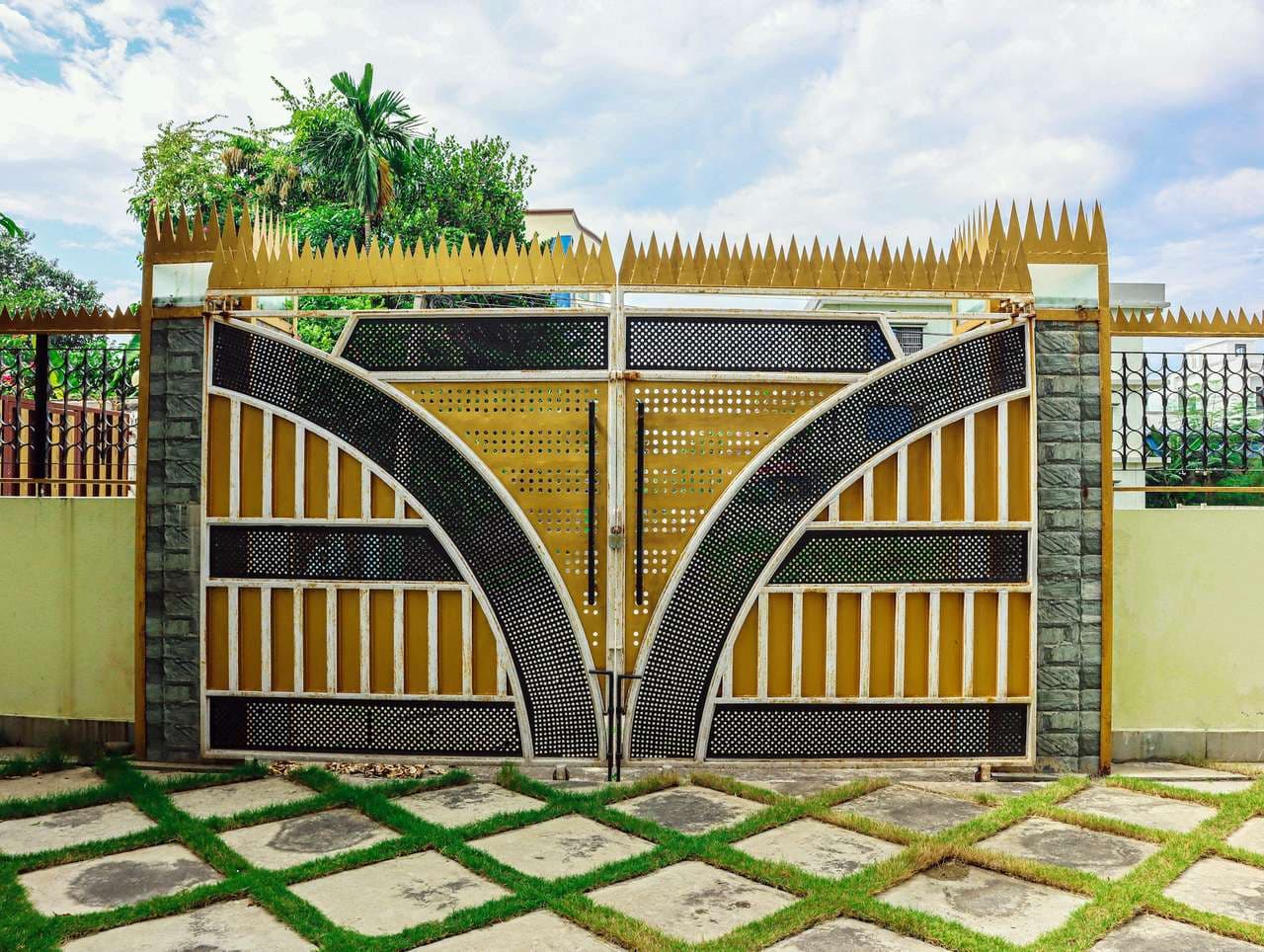
The jaali is an old idea in north Indian architecture: a carved stone screen that lets air and light through while keeping privacy. Laser cutting has brought it into everyday metalwork. Across Gurugram and Noida, laser-cut panels now appear in main gates, balcony screens, boundary walls, staircase railings and shop facades. Here is what the term means and what to check before ordering one.
How does CNC laser cutting work?
CNC stands for computer numerical control. The pattern is drawn as a vector file; the machine moves a focused laser beam (often a fibre laser for metal) along those lines, melting and vaporising the metal while an assist gas blows the molten metal out of the cut. The result is a precise cut with a narrow kerf and little distortion. Because the design is digital, it can be repeated exactly across many panels or changed for each one.
Which metals and thicknesses are used?
| Material | Typical sheet thickness for screens | Finish | Notes |
|---|---|---|---|
| Mild steel (MS) | Commonly about 1.5–3mm; thicker for gates | Primer and paint, powder coating | Strongest per cost; must be coated |
| Stainless steel | Commonly about 1–2mm | Brushed, mirror, PVD colour | No coating needed; costlier |
| Aluminium | Commonly about 2–4mm | Powder coating, anodising | Light, rust-free; good for facades |
| Corten (weathering steel) | Commonly about 2–3mm | Natural rust patina | Stains surfaces below; mostly decorative |
Thin sheet with a dense pattern is flexible, so jaali panels are almost always framed in a steel or aluminium section, as on a MS main gate or MS safety door.
Where laser-cut jaali works
- Gates: decorative panels inside a gate frame; see the main gate design guide.
- Window grills: a patterned grill instead of plain bars on an MS window grill; the guide to window grill designs and safety covers spacing.
- Balcony and stair railings: jaali infill panels on MS balcony railings or a staircase railing.
- Facades and screens: shopfront screens, building skins in aluminium, AC-unit covers, terrace privacy screens.
- Interiors: room dividers and pooja room doors, often in stainless or powder-coated aluminium.
Where to be careful
- Railings and grills must still meet safety needs: openings small enough that a child cannot climb or slip through.
- Large flat panels in wind need stiffening; thin sheet can drum or rattle.
- Very intricate patterns in thin MS are harder to coat evenly inside every cut.
How do you check a jaali before it's made?
- Ask for the design drawing at full scale, with the panel size and margins.
- Confirm the material and sheet thickness in writing.
- Ask how the panel is framed and fixed: welded, bolted or riveted.
- Confirm the finish: for MS, cut edges must be cleaned and coated; see powder coating.
- For outdoor MS, ask about hot-dip galvanising under the paint if long life matters.
Common confusions
"CNC jaali" sometimes means CNC-routed MDF or wood screens used in interiors; those are a different product. Plasma-cut panels are also sold: plasma cutting is cheaper on thick plate but leaves a wider, rougher edge than laser. And aluminium louvres are slatted, not perforated; they control rain and sun differently from a jaali.
Care
Dust collects in the cut-outs, so brush or blow panels clean regularly and wash with mild soap. On painted or powder-coated mild steel, touch up chips quickly; rust on a jaali tends to start at the cut edges. If an older gate shows rust, see metal gate or grill rusting.
Where FabWise uses it
Laser-cut panels can be part of gates, grills, railings and screens in our metal fabrication range. Design, material and finish are agreed after a site visit and written into the quote.
Common questions
Which is better for a jaali gate: MS or stainless steel?
MS is stronger per rupee and takes any paint or powder colour, but needs a good coating and touch-ups to avoid rust, especially at cut edges. Stainless steel needs no coating and suits a modern metallic look, but costs more and is usually used in thinner sheet. For large main gates, MS with a quality finish is the common choice.
Can I get my own design laser cut?
Yes. Because laser cutting works from a digital file, almost any pattern can be cut: geometric designs, florals, a family name or a logo. The design must leave enough metal between cut-outs for strength and must suit the sheet thickness. A full-scale drawing should be approved before cutting.
Does a laser-cut jaali gate rust?
An MS jaali will rust if the coating fails, and the many cut edges are the weak points. Proper cleaning of the edges, a good primer and paint or powder coat, and quick touch-ups keep it protected. Galvanising under the finish, or using stainless steel or aluminium, avoids the problem.
Jaali design wala grill safe hota hai kya?
It can be, if the sheet is thick enough, the panel is firmly framed and anchored to the wall, and the openings are small enough that nobody can reach through or climb it. A thin, unframed jaali is mostly decorative. Ask for the sheet thickness and frame size in the quote.
Services on this page
Related terms
- Mild steel (MS)Mild steel (MS) is low-carbon steel, typically about 0.05–0.25% carbon, that is strong, easy to cut and weld and inexpensive, but rusts unless it is primed and painted, powder coated or galvanised.
- Powder coatingPowder coating is a dry finish in which electrostatically charged polymer powder is sprayed onto pretreated metal and baked in an oven, forming a tough, even film that usually outlasts liquid paint on gates, railings, windows and grills.
- ACP fire-retardant (FR) coreAn FR-core ACP is an aluminium composite panel whose core between the two aluminium skins is heavily filled with mineral fire retardants instead of plain polyethylene, so it resists ignition and flame spread far better than a standard PE-core panel.
- Aluminium sectionsAluminium sections are extruded aluminium alloy profiles, most often alloy 6063 in a T5 or T6 temper, that form the frames of windows, sliding doors, partitions, louvres and facades, finished by anodising or powder coating.
- Back-painted glassBack-painted (lacquered) glass is glass with an opaque coloured coating applied to its rear face, so the colour is seen through a glossy glass surface; it is used for wall cladding, splashbacks and writing boards.
- Double-glazed unit (DGU)A double-glazed unit (DGU, or insulated glass unit) is two panes of glass held apart by a spacer and sealed around the edge, with dry air or gas trapped between them to cut heat and noise.
Where it is used
- MS & SS Metal FabricationGates, sliding gates, window grills, safety doors, staircases and mezzanines in mild and stainless steel.
- Iron gate or window grill is rusting and the paint is flaking
- Sliding gate is stuck, jerky or hard to push along its track
- Main gate has sagged and drags on the floor when opened