

Glossary · Facades & shutters · Gurgaon & Noida
Louvres: angled slats for shade, air and privacy
Louvres are rows of angled slats, called blades, that let air and some light pass while blocking direct sun, rain and sightlines. On buildings they are usually aluminium, either fixed at one angle or operable so the blades can be turned. They are used on facades, AC and shaft screens, windows, gates and pergola roofs.
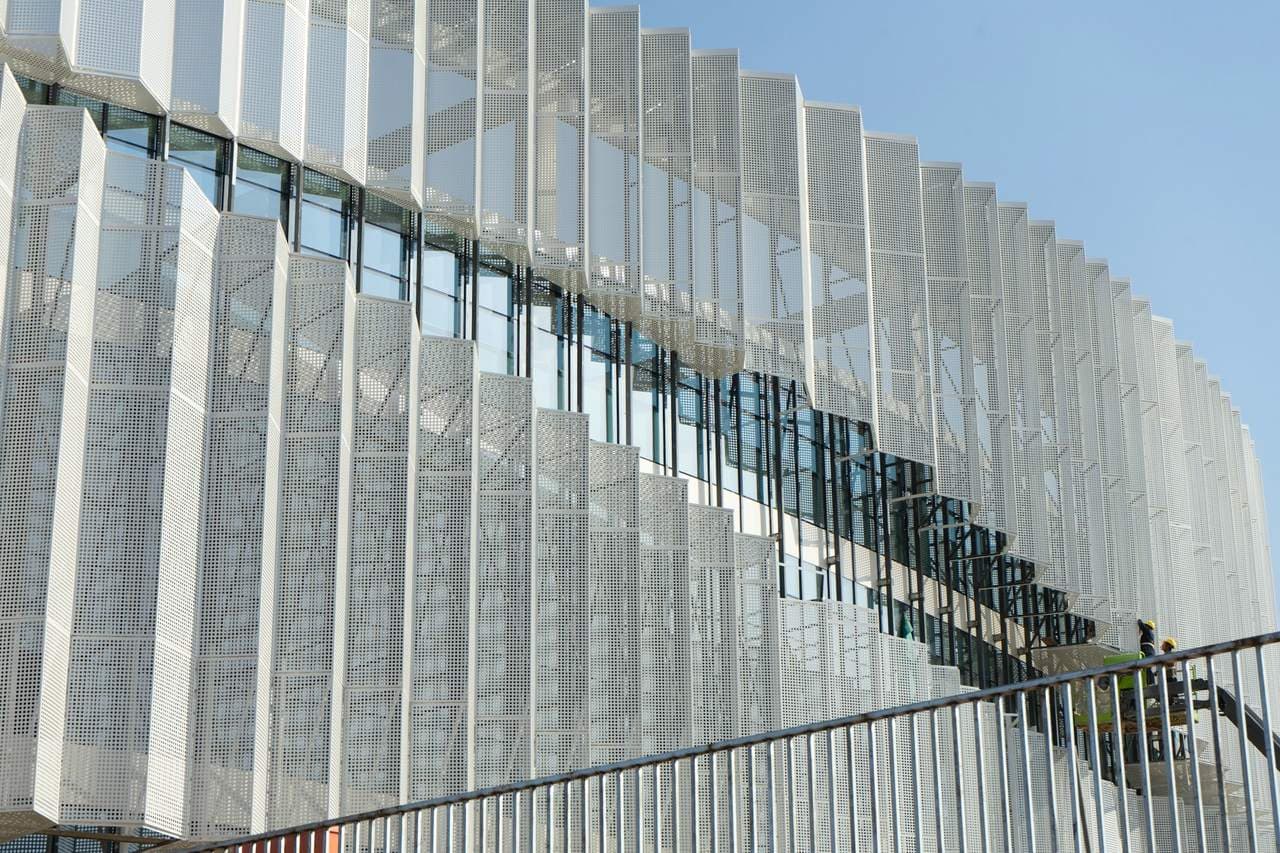
In a climate like Gurugram's, where afternoon sun on a west wall is brutal for half the year, louvres are one of the most effective things you can add to a building. They shade glass before the heat gets in, hide AC outdoor units and service shafts, and give a facade texture. The spelling varies, louvre or louver; both mean the same thing.
How do louvres work?
Each blade is set at an angle so it blocks a direct line through the opening. Sun hitting the outside of the blade is stopped or reflected; air passes around the blades; light enters indirectly. Rain is shed down the face if the angle and blade shape are right. The spacing between blades and their angle set the trade-off between view, airflow, shade and rain protection.
What types of louvres are there?
| Type | How it works | Typical use |
|---|---|---|
| Fixed horizontal | Blades set at a fixed tilt | Sun shading over south-facing glass, vent screens |
| Fixed vertical fins | Upright fins, sometimes angled | East and west facades where the sun is low |
| Operable (adjustable) | Blades rotate by hand lever or motor | Pergola roofs, windows, variable shading |
| Weather or rain louvres | Chevron or Z-shaped blades with a drip lip | Plant rooms, AC ledges, ventilation openings |
| Aerofoil blades | Wing-shaped extruded blades | Large architectural sun-shading |
| Glass louvres | Glass slats in a rotating frame | Bathroom and kitchen ventilators |
What are louvres made of?
Most architectural louvres are extruded aluminium sections: light, rust-free and available in aerofoil, rectangular, Z and C blade profiles. They are finished by powder coating, anodising or wood-effect coating. Steel louvres are stronger but need full rust protection; see hot-dip galvanising. Wood and WPC louvres are used where a warm look matters more than maintenance.
Where louvres are used
- Facades: sun-shading screens on offices and shop buildings, often combined with ACP cladding or structural glazing.
- Service screens: hiding AC outdoor units, shafts and generator areas while keeping airflow.
- Pergolas: operable louvre roofs that open for sun and close for shade or light rain, an alternative to an MS pergola with fixed slats.
- Gates and boundary walls: horizontal slat designs that give privacy without a solid sheet.
- Windows and ventilators: glass louvre windows in bathrooms and kitchens.
Where louvres fall short
- They are not fully waterproof unless designed as rain louvres; wind-driven rain can still get through standard blades.
- Fixed blades block some view and daylight at all times.
- Operable louvres have moving parts that need cleaning and occasional adjustment.
How do you check a louvre system?
- Ask for the blade profile and size, wall thickness and the span between supports.
- Check the sub-frame and fixings: long spans need intermediate support or blades sag and flutter.
- Confirm the finish and its colour code.
- For operable louvres, check the mechanism, pivots and whether rainwater has a gutter.
- For ventilation louvres, ask about free area, the actual open area for airflow.
Common confusions
Louvres are not the same as a CNC laser-cut jaali, which is a perforated flat sheet, nor a rolling shutter, which closes an opening completely. "Louvre door" in furniture means slatted wooden cabinet doors, a different product.
Care and common problems
Wash blades with water and mild detergent; dust settles on the top faces in NCR summers. Check fixings yearly. Blades that clatter in wind usually have loose clips or long unsupported spans; see louvres rattling.
Where FabWise uses it
Aluminium louvers are part of our facades and shutters range, quoted after a site visit where orientation, span and fixing are checked. For commercial buildings, see offices.
Common questions
Louvre or louver: which spelling is correct?
Both are correct. "Louvre" is the British and Indian spelling, "louver" the American one. They refer to the same thing: rows of angled slats that let air and light through while blocking direct sun, rain and views. Search engines and suppliers in India use both, so you will see both on quotes and catalogues.
Do aluminium louvres stop rain?
Standard sun-shading louvres shed most rain but are not watertight; wind-driven rain can blow through. Rain or weather louvres use chevron or Z-shaped blades with drip lips to block more water, and are used for plant rooms and vents. Operable pergola louvres close tightly and drain water into a gutter in the frame.
Are louvres good for a west-facing office facade in Gurgaon?
Yes, they are one of the most effective ways to cut heat on a west face. Because the evening sun is low, vertical fins or closely spaced angled blades usually work better than flat horizontal ones there. The blade angle, depth and spacing should be chosen to block the sun while keeping some view.
Louvres hawa mein awaaz kyun karte hain?
Usually because the blades are loose in their clips or brackets, the span between supports is too long so blades flutter, or fixings have worked loose over time. Tightening or replacing clips, adding intermediate supports and fitting rubber packers commonly stops the noise. Check that the sub-frame is firmly anchored too.
Services on this page
Related terms
- ACP fire-retardant (FR) coreAn FR-core ACP is an aluminium composite panel whose core between the two aluminium skins is heavily filled with mineral fire retardants instead of plain polyethylene, so it resists ignition and flame spread far better than a standard PE-core panel.
- Spider fittingsSpider fittings are stainless steel brackets with one to four arms that hold glass panels at their corners through drilled holes, creating frameless point-fixed glass facades, canopies and walls.
- Structural siliconeStructural silicone is a high-strength silicone sealant engineered to bond glass to a supporting frame and carry wind and weight loads, used in structural glazing facades.
- Tinted glassTinted glass is glass coloured throughout its body, typically grey, bronze, green or blue, so that it cuts glare and absorbs part of the sun's heat.
- Aluminium sectionsAluminium sections are extruded aluminium alloy profiles, most often alloy 6063 in a T5 or T6 temper, that form the frames of windows, sliding doors, partitions, louvres and facades, finished by anodising or powder coating.
- Back-painted glassBack-painted (lacquered) glass is glass with an opaque coloured coating applied to its rear face, so the colour is seen through a glossy glass surface; it is used for wall cladding, splashbacks and writing boards.
Where it is used
- ACP Cladding, Facades & ShuttersACP cladding, structural glazing, aluminium louvres and rolling shutters for shops and buildings.
- Rolling shutter is stuck halfway, jammed or too heavy to lift
- ACP cladding panel is loose, bulging or coming off the wall
- ACP cladding has faded, chalked or turned patchy in colour