

Glass glossary · Gurgaon & Noida
What is tinted glass?
Tinted glass is glass coloured right through its thickness, usually grey, bronze, green or blue, by adding metal oxides to the glass mix. It cuts glare and absorbs part of the sun's heat, but it also gets hot itself, which is why large sunlit tinted panes are often toughened or heat-strengthened.
How is tinted glass made?
Body-tinted glass is made on the float line like clear glass, with small amounts of metal oxides added to the batch: iron for green, cobalt and nickel for grey or bronze shades. The colour runs through the whole thickness, so it can't scratch off. A thicker pane of the same tint looks darker and absorbs more, which is worth knowing if you are matching an existing facade.
Body tint, reflective, or film?
| Type | What it is | Typical look | Heat control |
|---|---|---|---|
| Body-tinted | Colour in the glass itself | Uniform grey, bronze, green or blue | Absorbs part of the solar heat; modest |
| Reflective (coated) | A metallic coating, often on tinted or clear glass | Mirror-like by day from outside | Reflects more of the heat away; stronger |
| Solar-control low-E | A thin, mostly invisible coating in a sealed unit | Near-neutral, slight tint | Strongest balance of daylight and heat control |
| Tint film | A plastic film applied to existing glass | Varies | Variable; ages and can bubble |
What does tint actually do?
- Glare: tint reduces visible light transmission, which is the main comfort gain at a west-facing desk or shopfront.
- Heat: body tint absorbs a share of solar energy. Part of that heat is re-radiated into the room, so tint alone is a weaker heat barrier than a reflective or low-E coating.
- Privacy by day: tinted and especially reflective glass is harder to see into in daylight. At night, with lights on inside, the effect reverses.
- Appearance: facades and shopfronts often use tint to match a building's colour scheme.
When comparing products, ask for two numbers from the supplier's data sheet: VLT (visible light transmission, how much daylight gets through) and SHGC or solar factor (how much of the sun's heat gets through). A darker glass is not automatically a cooler one.
Why are tinted panes prone to thermal cracking?
Because tinted glass absorbs heat, a pane in sun can get much hotter in its exposed middle than at its edges, which sit cool inside the frame or behind a shadow. That temperature difference stresses the glass, and annealed tinted glass can crack from the edge in a characteristic wandering line. Fitters reduce the risk with clean edges and, for large or partly shaded sunlit panes, by specifying heat-strengthened or toughened glass, which tolerates far larger temperature differences.
Where is it used, and where isn't it ideal?
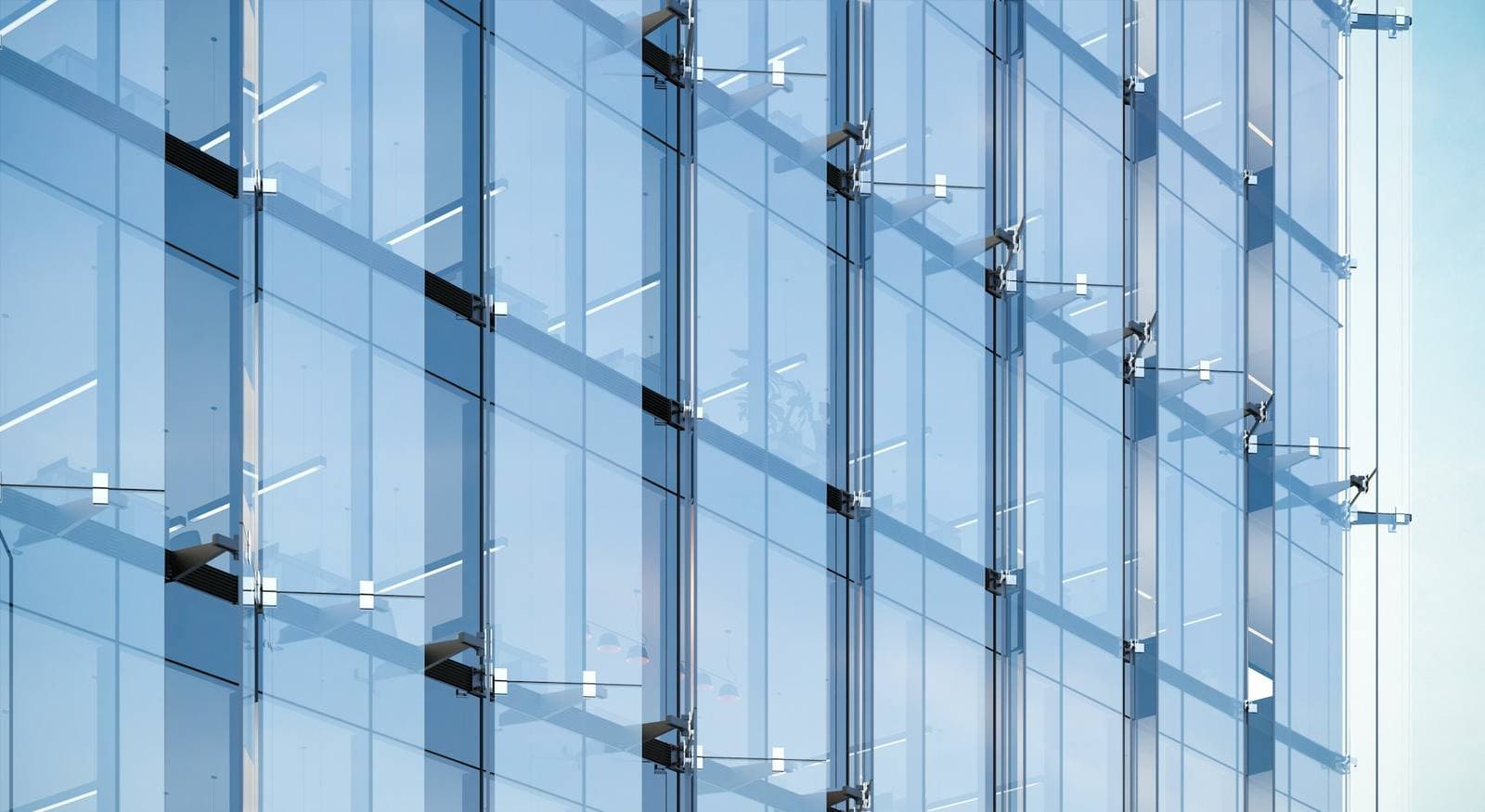
- Commercial facades and structural glazing, usually as part of a coated or double-glazed build-up.
- West- and south-facing windows and shopfronts that suffer afternoon glare.
- Decorative interiors: bronze or grey glass in partitions, wardrobe shutters and table tops.
It is less suited where daylight is precious, such as a north-facing room or a deep office floor, or for a shopfront whose job is to show the goods: dark tint makes window displays hard to see from the pavement by day.
How do you identify it?
Look at the edge of the pane: tinted glass shows its colour strongly along the edge, and a scratch through the surface shows the same colour beneath. Film-tinted glass has a clear edge and a visible film line near the frame. Reflective glass looks mirror-like from the bright side.
Common confusions
- Tinted vs low-E: low-E glass controls heat with a thin coating while staying close to clear; tint controls glare with colour.
- Tinted vs frosted: frosted glass blocks the view; tinted glass stays transparent.
- Tinted vs smoked mirror: smoked or bronze mirrors use tinted glass with a mirror backing.
- Clear vs extra-clear: ordinary clear glass has a faint green tint from iron. Low-iron, extra-clear glass removes it.
Care
Clean tinted glass as you would clear glass. On reflective coated glass, follow the supplier's instruction on which face is coated, and avoid abrasive pads or blades on the coating. Keep blinds and heavy posters a little away from sunlit tinted panes; trapping heat between them and the glass raises thermal stress.
Tinted glass and FabWise
FabWise's published glass styles use clear Saint-Gobain toughened glass. Tinted, reflective and facade glazing are part of the facades and shutters family in Gurugram and Noida, quoted after a site visit, with the glass type chosen for the orientation and the building.
Common questions
Does tinted glass keep a room cool?
Partly. Body-tinted glass absorbs some solar heat and cuts glare, but it also warms up and re-radiates part of that heat inside. Reflective glass and solar-control low-E coatings, especially in a double-glazed unit, usually do a better job of keeping heat out while letting in more daylight. Compare the solar factor (SHGC) on the data sheet.
Why did my tinted window crack in the sun?
Most likely thermal stress. Tinted glass absorbs heat, so the sunlit centre of the pane expands while the edges in the frame stay cooler. If the glass is annealed and its edges are chipped, that difference can start a crack from the edge. Replacing it with toughened or heat-strengthened glass greatly reduces the risk.
Can people see through tinted glass at night?
Yes, if the inside is lit. Tinted and reflective glass are harder to see into by day because the outside is brighter. After dark, with lights on indoors, the effect reverses and people outside can see in, while you see mostly reflections. Use blinds or frosted glass where night-time privacy matters.
Tinted glass aur sun control film mein kya fark hai?
Tinted glass has the colour inside the glass itself, so it can't scratch off or peel and lasts the life of the window. Sun control film is a plastic layer stuck on existing glass: cheaper and quick to apply, but it can bubble, fade and scratch over the years, and some films raise the risk of thermal cracking on annealed glass.
Services on this page
Related terms
- ACP fire-retardant (FR) coreAn FR-core ACP is an aluminium composite panel whose core between the two aluminium skins is heavily filled with mineral fire retardants instead of plain polyethylene, so it resists ignition and flame spread far better than a standard PE-core panel.
- LouvresLouvres are a series of angled horizontal or vertical slats, usually in aluminium, fixed or adjustable, that let air and filtered light through a facade, window, vent or pergola while blocking direct sun, rain and views.
- Spider fittingsSpider fittings are stainless steel brackets with one to four arms that hold glass panels at their corners through drilled holes, creating frameless point-fixed glass facades, canopies and walls.
- Structural siliconeStructural silicone is a high-strength silicone sealant engineered to bond glass to a supporting frame and carry wind and weight loads, used in structural glazing facades.
- Aluminium sectionsAluminium sections are extruded aluminium alloy profiles, most often alloy 6063 in a T5 or T6 temper, that form the frames of windows, sliding doors, partitions, louvres and facades, finished by anodising or powder coating.
- Back-painted glassBack-painted (lacquered) glass is glass with an opaque coloured coating applied to its rear face, so the colour is seen through a glossy glass surface; it is used for wall cladding, splashbacks and writing boards.
Where it is used
- ACP Cladding, Facades & ShuttersACP cladding, structural glazing, aluminium louvres and rolling shutters for shops and buildings.
- Rolling shutter is stuck halfway, jammed or too heavy to lift
- ACP cladding panel is loose, bulging or coming off the wall
- ACP cladding has faded, chalked or turned patchy in colour