
Shower glass repair · Gurgaon & Noida
Black mould in shower partition silicone: clean it or re-seal it?
Black spots in shower silicone are mould growing in, and often under, the sealant where water sits. Surface mould sometimes cleans off, but once it's inside the bead no cleaner will reach it. The fix is cutting the old silicone out, drying and cleaning the joint, and re-sealing with a mould-resistant sanitary silicone.
Why the silicone goes black
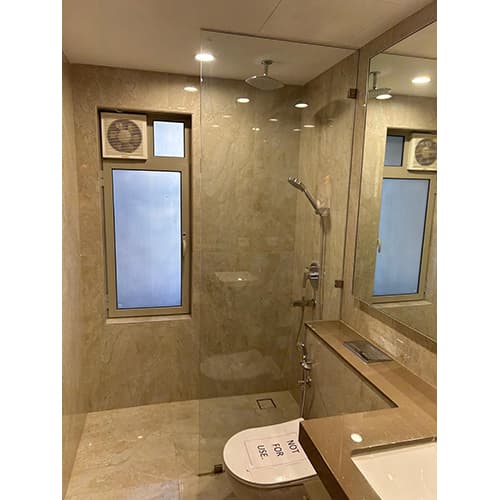
The silicone bead where a shower partition meets the wall and floor tiles is there to keep water inside the shower. It's also the dampest, least ventilated spot in the bathroom. Mould spores land on soap residue and body oils stuck to the bead, find a constant supply of water, and grow. In flats across Gurugram, where many bathrooms have only a small exhaust fan and no window, the joint barely dries between morning and evening showers.
The first sign is grey speckling. Left alone, it turns into black streaks that go into the sealant, and sometimes behind it if the bead has lifted at an edge.
What makes some showers mould faster
Water standing against the bead
If the shower tray or floor doesn't fall towards the drain, water pools along the glass line and soaks the silicone for hours. The same happens when the bead was run on the inside face of the glass where every shower hits it.
The wrong sealant
General-purpose or construction silicone has little or no fungicide. Bathroom joints need a sanitary-grade silicone, and on glass and stone a neutral-cure type is commonly preferred. It isn't the same product as the structural silicone used on building facades, which has a different job.
A bead applied over old mould
Fresh silicone squeezed over an old, mouldy joint traps the spores underneath. It looks clean for a few weeks, then the black comes back through.
A joint that has lifted
Once the bead peels at an end, water gets behind it and mould grows where nothing can reach. A lifted joint is also a leak path: see shower door leaking.
| What you see | What it means | What to do |
|---|---|---|
| Grey speckles that wipe off | Surface mould on residue | Clean and improve ventilation |
| Black that stays after cleaning | Mould inside the bead | Cut out and re-seal |
| Black behind clear silicone | Mould under a lifted bead | Cut out, dry, re-seal |
| Mould returns within weeks | Water pooling or wrong sealant | Fix the fall or bead position, use sanitary silicone |
| Damp patch on the wall outside | Joint is leaking | Re-seal; check the seal strip too |
What you can try yourself
- Ventilate: run the exhaust fan during and for a while after every shower.
- Squeegee the glass and wipe the joint dry after use.
- Clean the bead with a diluted bleach solution on a cloth, left for a few minutes, then rinse well.
- If the black is still there after two attempts, it's inside the silicone and cleaning won't remove it.
How a re-seal is done, and how it's quoted
A proper re-seal isn't a new bead on top. The old silicone is cut out completely, residue removed from tile and glass, the joint cleaned with a fungicidal wash and left to dry, and then a sanitary silicone is run in a continuous bead where it will shed water rather than hold it. The shower usually shouldn't be used until the silicone has cured, often about a day.
It's quoted like any repair, from photos on WhatsApp, with no paid visit. Send a wide shot of the partition, close-ups of the black joints and any damp patch outside the shower. If a worn bottom seal or a sagging door is pushing water at the joint, it makes sense to fix that at the same time; the bathroom glass door hinge replacement covers door hardware.
Keeping the new seal clean
- Squeegee the glass after each shower; it takes thirty seconds.
- Keep the exhaust fan working and clean its grille.
- Use mild, non-acidic cleaners on the silicone.
- Deal with hard-water build-up early; see hard water stains on shower glass.
If water is escaping along the bottom of the door rather than the silicone, see shower seal strip worn. Our shower glass hard-water cleaning guide covers safe products, and the glass repair catalogue lists every bathroom fix. For homes across the city see shower cubicles in Gurgaon. Send a photo of the joint on WhatsApp and we'll tell you whether it needs re-sealing.
Common questions
Can black mould in shower silicone be cleaned?
Only if it's on the surface. A diluted bleach solution on a cloth can lift surface mould. If the black stays after a couple of attempts, the mould has grown into or behind the silicone, and the only real fix is cutting it out and re-sealing.
How often should shower partition silicone be replaced?
There's no fixed interval. A well-ventilated shower with the right sanitary silicone and no standing water can go years. If it turns black within months, something else is wrong: water pooling at the joint, the bead in the wrong place, or a sealant without fungicide.
Can I put new silicone over the old one?
It's not a good idea. New silicone doesn't bond well to old silicone, and it traps the mould underneath, which shows through again within weeks. The old bead should be cut out fully, the joint cleaned and dried, then re-sealed.
Shower ke glass ki silicone kaali ho gayi hai, kya ye leak karegi?
Not necessarily, but often the black comes with a lifted joint, and that does leak. Check for a damp patch on the wall or floor outside the shower. Send a close-up photo on WhatsApp and we'll tell you whether it needs re-sealing.