

Glass glossary · Gurgaon & Noida
Glass thickness guide: which thickness for which job?
Glass thickness is chosen by how big the pane is, how it is supported and what happens if it breaks. As a rule of thumb, 4–6mm suits framed windows, 8–10mm toughened suits shower screens, and 12mm toughened suits frameless office cabins, shopfronts and tall doors. Railings and overhead glass use laminated build-ups.
Typical thickness by use
| Use | Commonly used | Glass type | Why |
|---|---|---|---|
| Small framed window panes | 4–5mm | Annealed or toughened | The frame supports all four edges |
| Larger sliding windows, cabinet doors | 5–6mm | Toughened preferred | Bigger panes and frequent handling |
| Double-glazed windows | 5mm or 6mm per pane | Varies | See double-glazed units |
| Framed / slim-profile shower screens | 8mm | Toughened | Frame adds stiffness |
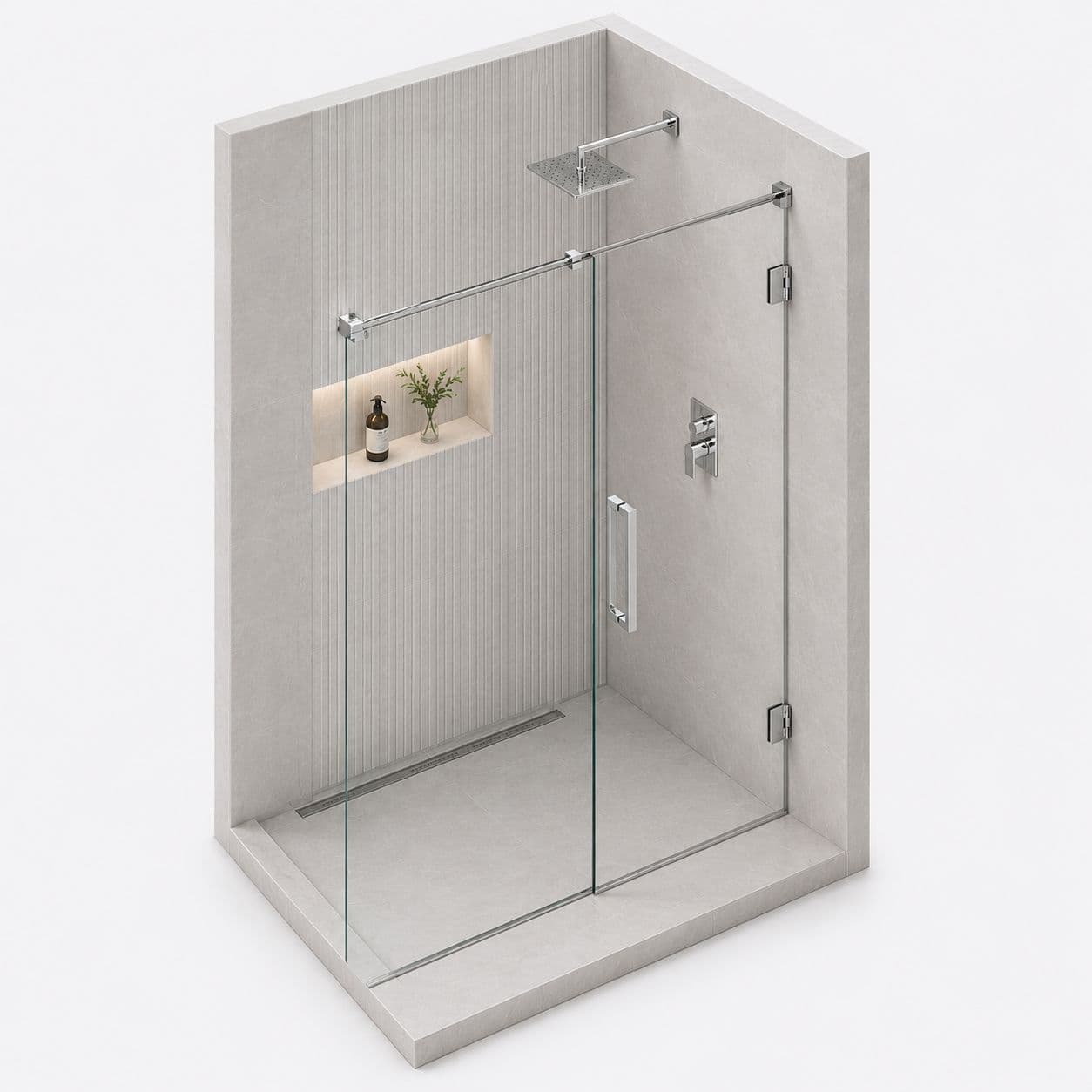
| Frameless shower partitions and doors | 10mm (8mm for small fixed panels) | Toughened | Panels stand with few fixings and are wet daily |
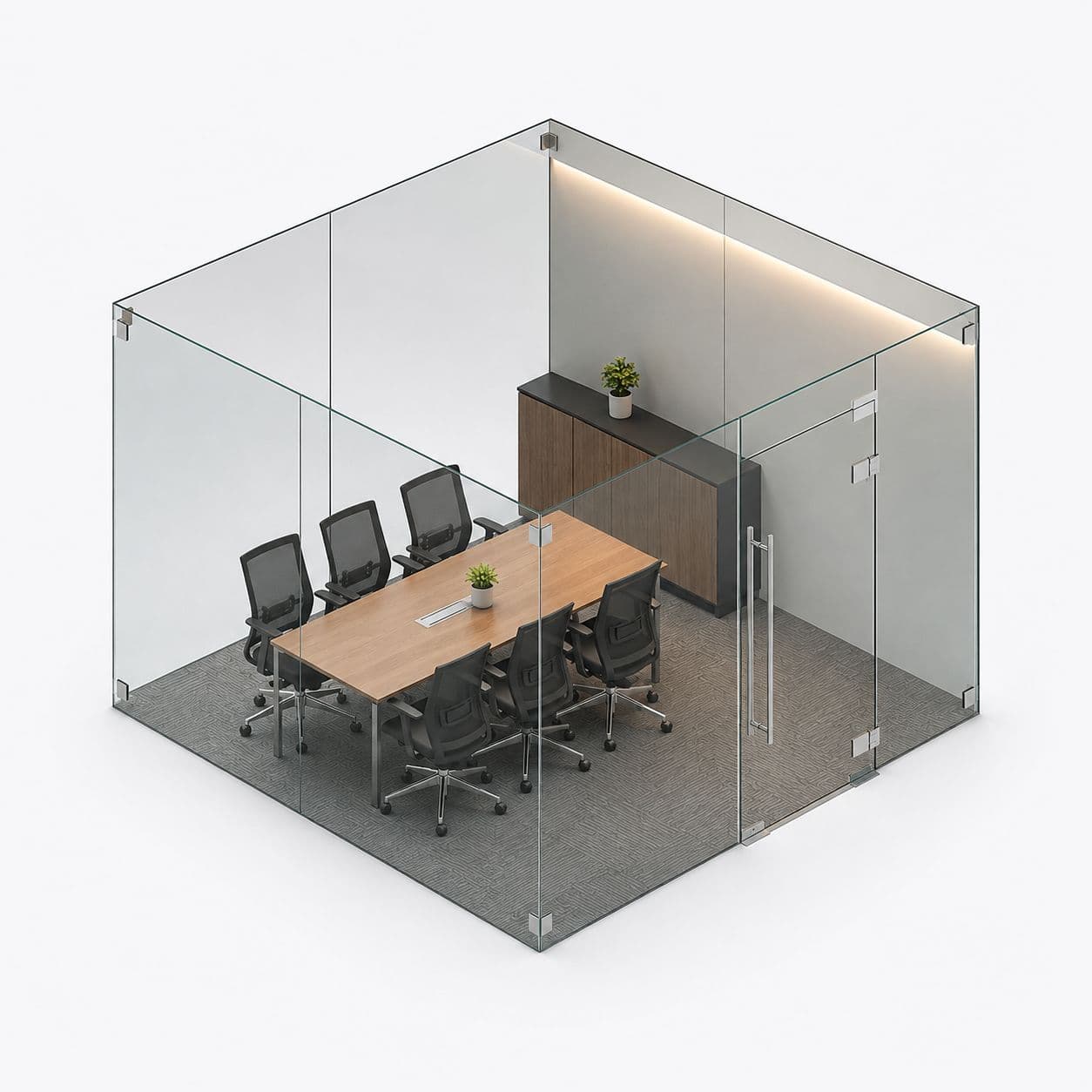
| Office cabins, full-height partitions | 12mm | Toughened | Tall spans, doors on floor springs, foot traffic |
| Shopfront doors and fixed glass | 12mm | Toughened | Heavy use and exposure to the street |
| Shelves | 8–10mm | Toughened | Depends on span and load |
| Table tops | 8–12mm | Toughened | Larger tops need more |
| Balcony and stair railings | Laminated, e.g. 6+6mm or more | Toughened laminated | Must stay in place if broken; engineered by supplier |
| Canopies and skylights | Laminated build-ups | Toughened or heat-strengthened laminated | Overhead glass must not fall |
Read the table as typical practice, not a rule book. The right answer for a given pane depends on its height and width, how many edges are supported, how it's fixed, wind exposure (for windows and facades) and who might fall against it. Indian guidance on the human-impact side sits in IS 16231 (Part 4), and for railings and overhead glazing the glass supplier or a structural engineer should confirm the build-up.
Why do showers use 10mm and offices 12mm?
A frameless shower panel is often under 2.1 metres tall and is held by a few clamps, hinges or a channel. At 10mm, toughened glass is stiff enough not to flex noticeably when a door is pushed, while staying light enough for wall hinges to carry. An office cabin wall is usually taller, often full room height, spans wider runs, and its door swings on a floor spring dozens of times a day. The extra 2mm makes the panel visibly stiffer and steadier under knocks. Our guide shower glass thickness: 8mm, 10mm or 12mm covers the bathroom choice in more detail.
How heavy is glass?
Glass weighs about 2.5 kg per square metre for every millimetre of thickness. In Indian units that is roughly:
- 8mm: about 1.9 kg per sq ft
- 10mm: about 2.3 kg per sq ft, so a 2 ft × 6.5 ft shower door is around 30 kg
- 12mm: about 2.8 kg per sq ft, so a 3 ft × 7 ft office door is close to 60 kg
Weight decides the hardware: a heavy door needs a floor spring rated for it, or enough glass-to-glass hinges of the right grade. The glass weight calculator works it out for any size.
Thicker isn't always better
- Thicker glass is heavier, which loads hinges and makes doors harder to swing. A 12mm shower door on wall hinges can be more trouble than a 10mm one.
- Thicker glass has a slightly stronger green edge colour, noticeable on extra-tall panels and stacked shelves.
- Hardware is matched to thickness: fittings for 10mm glass won't grip 12mm, and vice versa.
- Cost per sq ft rises with thickness, so overspecifying where it doesn't help is wasted money.
How do you check thickness on site?
Measure an exposed edge with a vernier or a steel rule. Nominal thicknesses have small manufacturing tolerances, so 10mm glass may measure a fraction under or over. On laminated glass, measure the total and look for the interlayer line; a 6+6 laminate with a 1.52mm interlayer measures about 13.5mm.
Common confusions
- Thick vs strong: thickness adds stiffness, but toughening is what multiplies strength. A thick annealed pane is still annealed.
- Thickness vs safety: a thick piece of annealed glass still breaks into sharp shards; laminated glass and toughened glass are the safety glasses.
- 12mm vs 13.52mm: the second is a laminate, two 6mm panes with an interlayer, not a single 13mm sheet.
What FabWise uses
FabWise's published styles fix the thickness for you: 10mm Saint-Gobain toughened glass for every bathroom partition, such as the frameless shower partition with door, and 12mm for office cabins and shopfronts, such as the frameless glass office partition with door, all with SS304 fittings. For shelves, table tops and one-off panels in Gurugram and Noida, the thickness is agreed when you send sizes for custom glass installation.
Common questions
Is 8mm or 10mm glass better for a shower partition?
For a frameless shower with a hinged door, 10mm toughened glass is the common choice: stiffer, steadier on its hinges and less prone to flexing when the door is pushed. 8mm works for framed or slim-profile screens, small fixed panels and sliders where hardware is designed for it. FabWise uses 10mm toughened glass for all its bathroom partitions.
What thickness of glass is used for office partitions?
Frameless office partitions and cabin doors are usually 12mm toughened glass, because the panels are tall, the doors are heavy and the walls take knocks from chairs and people. Framed aluminium partitions sometimes use thinner glass, but FabWise's office cabins, including the aluminium-framed style, use 12mm Saint-Gobain toughened glass.
How much does a 12mm glass door weigh?
Glass weighs about 2.5 kg per square metre per millimetre, so 12mm glass is roughly 2.8 kg per sq ft. A typical 3 ft by 7 ft office door, 21 sq ft, therefore weighs close to 60 kg before fittings. That is why such doors run on floor springs rather than ordinary hinges.
Balcony railing ke liye kitna mota glass chahiye?
Frameless glass balcony railings normally use laminated toughened glass rather than a single sheet, for example two 6mm toughened panes bonded with an interlayer, or a heavier build-up for taller or longer panels. The exact build-up depends on height, span, the fixing (channel or spigots) and the loads, and should be confirmed by the glass supplier or an engineer.
Services on this page
Related terms
- Fluted glassFluted glass is patterned glass with parallel vertical grooves or ribs pressed into one face, which blurs what is behind it while still letting light through.
- Glass-to-glass hingeA glass-to-glass hinge is a hinge that clamps two glass panels together so a glass door can swing directly off a fixed glass panel, used mainly in frameless shower enclosures.
- ACP fire-retardant (FR) coreAn FR-core ACP is an aluminium composite panel whose core between the two aluminium skins is heavily filled with mineral fire retardants instead of plain polyethylene, so it resists ignition and flame spread far better than a standard PE-core panel.
- Aluminium sectionsAluminium sections are extruded aluminium alloy profiles, most often alloy 6063 in a T5 or T6 temper, that form the frames of windows, sliding doors, partitions, louvres and facades, finished by anodising or powder coating.
- Back-painted glassBack-painted (lacquered) glass is glass with an opaque coloured coating applied to its rear face, so the colour is seen through a glossy glass surface; it is used for wall cladding, splashbacks and writing boards.
- CNC laser-cut jaaliA CNC laser-cut jaali is a decorative perforated screen cut from metal sheet, usually mild steel, stainless steel or aluminium, by a computer-controlled laser that follows a digital pattern, used in gates, partitions, grills, facades and railings.