

Hardware glossary · Gurgaon & Noida
What is a glass-to-glass hinge?
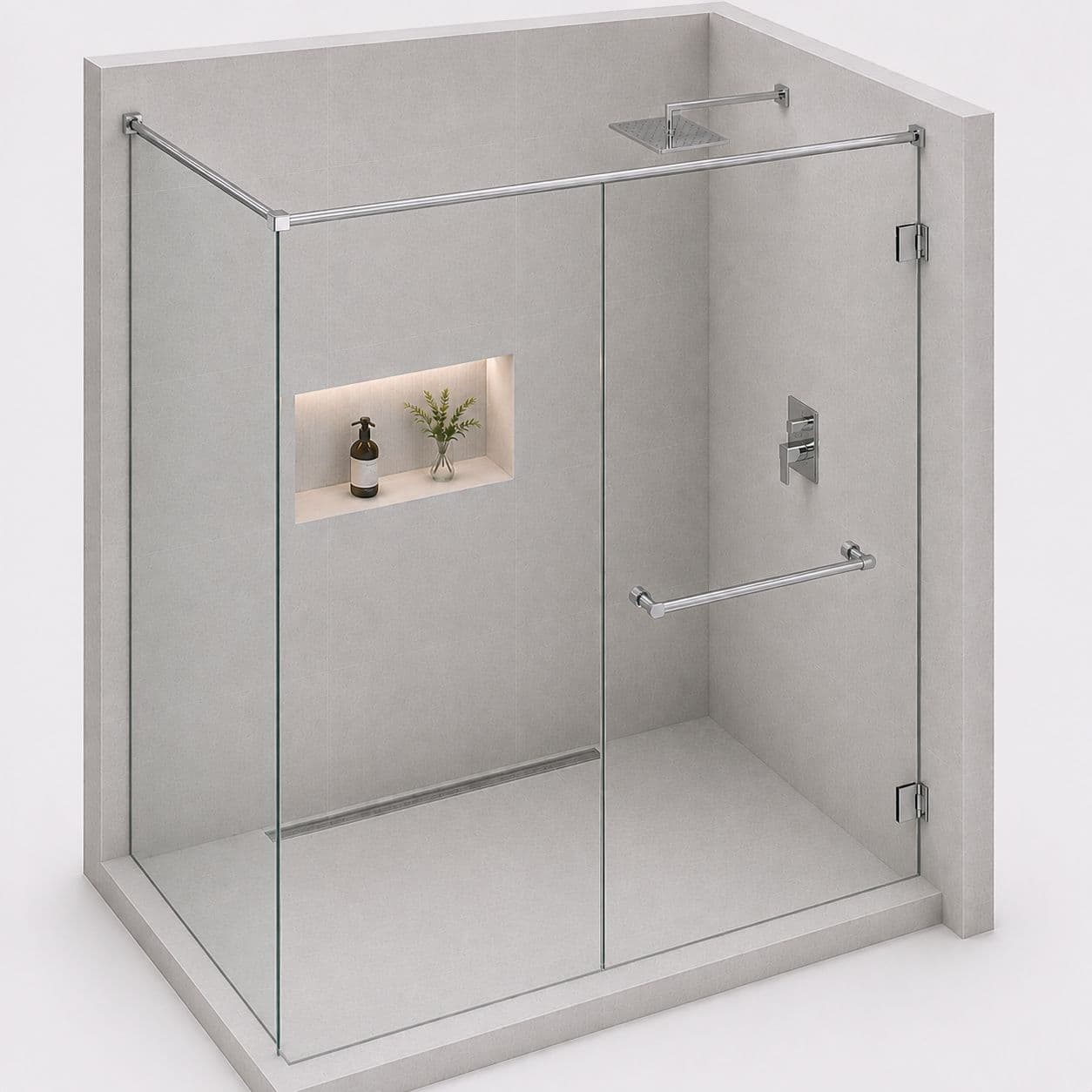
A glass-to-glass hinge connects a glass door straight to a fixed glass panel, with no wall or frame in between. It clamps through holes in both panels and lets the door swing. It's what makes frameless shower enclosures possible, and comes in 180° (in-line), 90° (corner) and 135° versions.
How does a glass-to-glass hinge work?
Each leaf of the hinge is a pair of metal plates that sandwich the glass, bolted through a hole or notch drilled in the panel before toughening. Gaskets between metal and glass protect the toughened glass from point pressure. One leaf clamps the fixed panel, the other clamps the door, and a pin between them lets the door turn. Many shower hinges have a built-in cam or spring that returns the door to the closed position, or holds it at zero and 90 degrees.
Which angle do you need?
| Hinge | Fixed panel to door angle | Typical layout |
|---|---|---|
| 180° glass-to-glass | In line (flat) | A straight wall-to-wall partition where the door hangs off a fixed side panel |
| 90° glass-to-glass | Right angle | An L-shaped corner enclosure where the door is on the return panel |
| 135° glass-to-glass | Angled | Neo-angle or diamond-shaped corner enclosures |
| Wall-to-glass (for comparison) | Door to masonry | A door hanging directly off a tiled wall |
The hinge angle follows the layout. A frameless shower partition with door across a bathroom often uses 180° hinges off a fixed panel; an L-shape frameless shower enclosure with door may need 90° hinges if the door sits on the corner. The sliding vs hinged shower door guide compares the alternative.
How many hinges does a door need?
Most shower doors use two. Tall doors, wide doors or heavy 10mm glass can call for three, or for heavier-rated hinges, because a glass door of about 2 ft by 6.5 ft weighs around 30 kg at 10mm and all of that hangs off the fixed panel. That also means the fixed panel itself must be held firmly, by a floor channel, wall clamps or a support bar where the design calls for one (the glass thickness guide explains why heavier panels need more support), or the whole assembly will slowly lean.
Materials and finishes
Hinges are commonly made of stainless steel or of brass with a chrome, satin, black or gold finish. In bathrooms, corrosion resistance matters more than looks: chlorinated and hard water will pit a low-grade finish within a few years. The grade of steel is covered in SS304 vs SS202.
Where is it used, and where not?
- Frameless showers where the door sits beside or at an angle to a fixed panel.
- Glass partitions in homes where a light door opens off a glass screen.
It is not for heavy office or shop doors, which hang on a floor spring with patch fittings, and it is no substitute for a slider in a bathroom where a swing door would hit the WC or basin.
Signs of wear
- The door drops at the handle side or rubs the floor: shower door sagging.
- The door is stiff, sticks or won't self-centre: shower door hinge stuck.
- The whole partition moves when the door is used: shower partition wobbling.
- Rust spots or flaking finish on the hinge body.
Common confusions
- Glass-to-glass vs wall-to-glass: the first joins two glass panels; the second fixes a door to a wall.
- Hinge vs clamp: a glass clamp holds two panels rigidly, with no movement; a hinge allows the door to swing.
- Lift hinges: some hinges rise slightly as the door opens so it clears the floor and drops to seal when closed.
Care
Rinse off soap and shampoo, wipe hinges dry, and avoid acidic or chlorine bleach cleaners on the finish. Don't lean or hang towels on an open door: the hinge carries the whole lever load. A stiff hinge often needs the cam re-set, not lubricating with oil, which attracts grime.
Hinges at FabWise
FabWise's bathroom styles in Gurugram and Noida use 10mm Saint-Gobain toughened glass with SS304 anti-rust fittings and carry a 1 year functional warranty on hardware. Worn or stuck hinges on an existing shower are handled under bathroom glass door hinge replacement, quoted from a photo on WhatsApp.
Common questions
What is the difference between a 90 and 180 degree glass hinge?
The number is the angle between the fixed panel and the door when closed. A 180° glass-to-glass hinge joins a door in line with a fixed panel, as in a straight partition. A 90° hinge joins a door at a right angle to the fixed glass, as on the return of an L-shaped corner enclosure. 135° suits angled enclosures.
How many hinges does a glass shower door need?
Two is standard for a normal shower door. A tall, wide or heavy door may need three, or hinges rated for more weight, since a 10mm door of typical size weighs roughly 30 kg. The fixed panel the hinges attach to must also be well supported, otherwise the whole assembly gradually sags.
Shower door hinge se paani tapakta hai, kya karein?
Water at a hinge usually comes through the gap between door and fixed glass, not through the hinge itself. A worn or missing seal strip on the door edge, or a door that has dropped out of line, are the usual causes. Re-aligning the door and replacing the seal strip normally stops it; check that the hinge isn't loose or corroded too.
Why is my shower door hinge stiff?
Self-closing hinges contain a cam or spring that can get gummed up with soap and limescale, or set too tight. A door that has dropped also binds. Cleaning the hinge, adjusting it and re-aligning the door usually helps. If the hinge is corroded or the mechanism is broken, replacing it with one suited to the glass thickness is the fix.
Services on this page
Related terms
- Fluted glassFluted glass is patterned glass with parallel vertical grooves or ribs pressed into one face, which blurs what is behind it while still letting light through.
- Glass thickness guideA glass thickness guide matches common glass thicknesses, from 4mm to 12mm and laminated build-ups, to the uses each one typically suits, based on span, support and safety.
- ACP fire-retardant (FR) coreAn FR-core ACP is an aluminium composite panel whose core between the two aluminium skins is heavily filled with mineral fire retardants instead of plain polyethylene, so it resists ignition and flame spread far better than a standard PE-core panel.
- Aluminium sectionsAluminium sections are extruded aluminium alloy profiles, most often alloy 6063 in a T5 or T6 temper, that form the frames of windows, sliding doors, partitions, louvres and facades, finished by anodising or powder coating.
- Back-painted glassBack-painted (lacquered) glass is glass with an opaque coloured coating applied to its rear face, so the colour is seen through a glossy glass surface; it is used for wall cladding, splashbacks and writing boards.
- CNC laser-cut jaaliA CNC laser-cut jaali is a decorative perforated screen cut from metal sheet, usually mild steel, stainless steel or aluminium, by a computer-controlled laser that follows a digital pattern, used in gates, partitions, grills, facades and railings.