

Hardware glossary · Gurgaon & Noida
What is a floor spring?
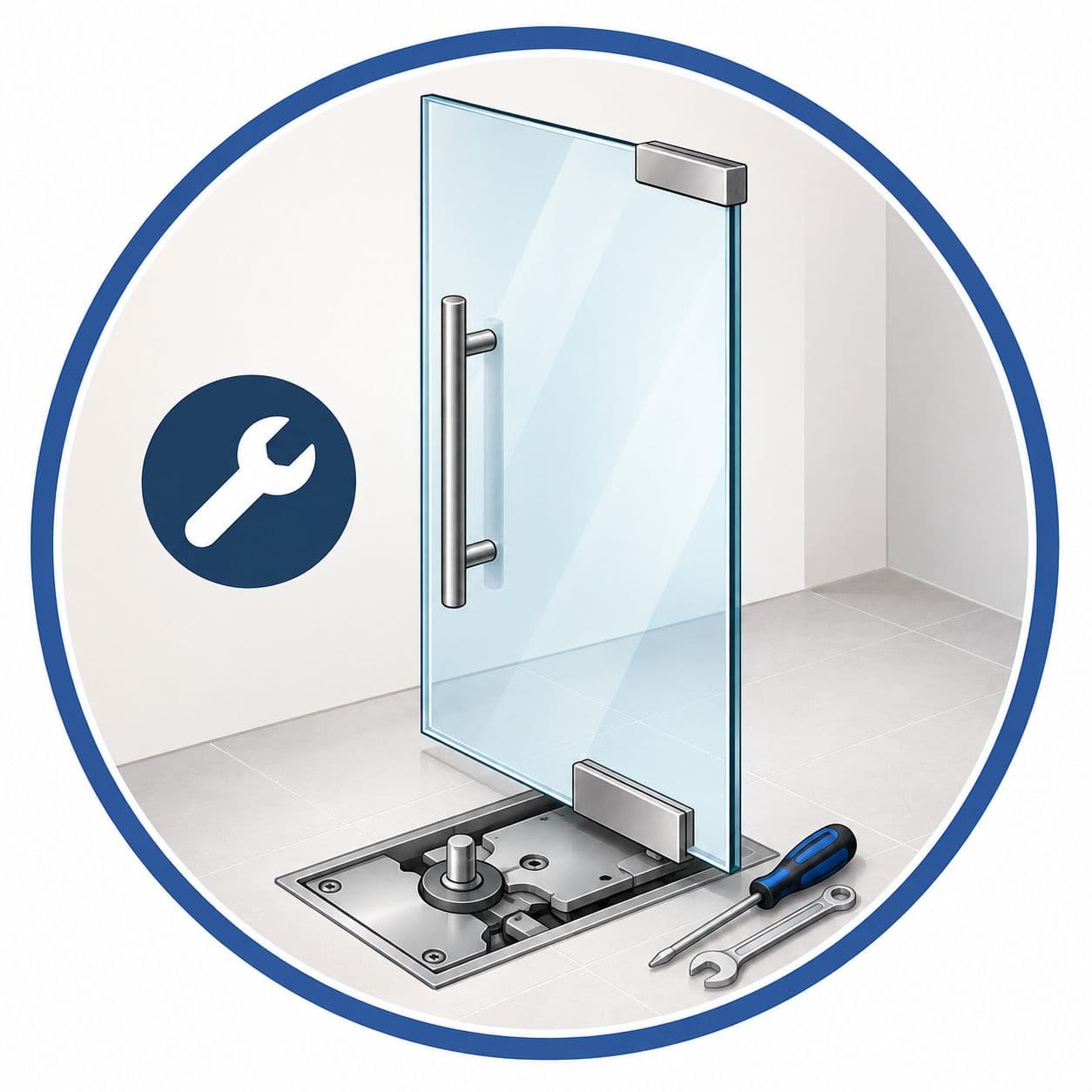
A floor spring, often called a floor machine or floor hinge in India, is a hydraulic door closer recessed into the floor under a door. The door's bottom fitting sits on its spindle, so it carries the door's weight and pulls it shut at a controlled speed. It is the standard way to hang heavy frameless glass doors.
How does a floor spring work?
Inside a steel body sit a strong coil spring and a hydraulic cylinder filled with oil. Opening the door turns the spindle, which compresses the spring. When you let go, the spring pushes the door back, and the oil, forced through small adjustable channels, slows it down so it closes smoothly instead of slamming. The body sits in a cement box set into the floor screed, and a stainless cover plate hides it.
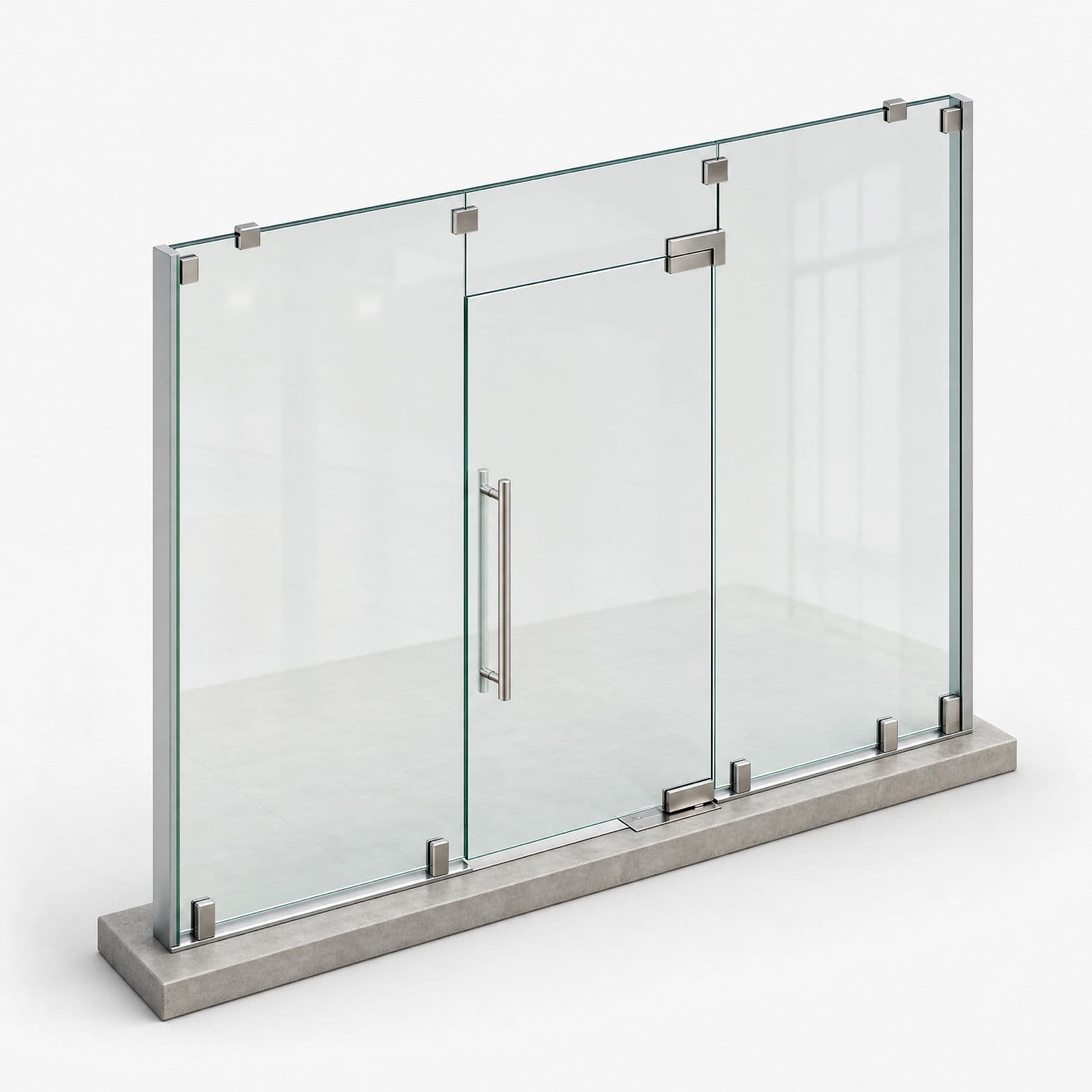
The door is connected in three places: a bottom patch fitting clamped to the glass sits on the floor spring's spindle, a top patch fitting holds a pivot pin, and that pin runs in a socket in the ceiling, transom or overhead glass. The floor spring therefore does two jobs: it is the door's lower hinge and its closer.
What can be adjusted?
- Closing speed: how fast the door swings from fully open to nearly closed.
- Latching speed: the last few degrees before the door meets its stop or centre line.
- Hold-open: many models can hold the door at around 90° (single-action doors) until pushed.
- Back-check on some models: extra resistance near full opening so the door doesn't fly back into a wall.
- Position: adjustable cement boxes allow small sideways and front-back alignment after installation.
Single action or double action?
A single-action door opens one way and closes against a stop. A double-action door swings both ways and returns to a centre position, typical of shopfronts, restaurants and clinic corridors. Floor springs are made for one or both, and the hold-open angle and adjustment differ between the two.
How are floor springs sized?
Closers are graded by closing force into numbered power sizes under the European standard EN 1154. A larger size suits a wider, heavier door. Manufacturers then add a maximum door weight and width for each model, and both limits matter: a narrow but heavy 12mm glass door may need a stronger unit than its width suggests. As a guide, glass weighs about 2.8 kg per sq ft at 12mm, so a typical cabin door is well over 50 kg before fittings.
| Floor spring | Hydraulic door closer (overhead) | |
|---|---|---|
| Where it sits | Recessed in the floor, invisible | Surface-mounted on the door head or frame |
| Carries door weight? | Yes, it is the bottom pivot | No, hinges carry the door |
| Suits | Frameless glass doors, double-action doors | Framed wooden, metal and aluminium doors |
| Installation | Floor must be cut; needs a cement box | Screwed on; easy to retrofit |
| Main failure | Oil leak, worn seals, rusted box | Oil leak, loose arm |
The full comparison is in floor spring vs door closer.
How do you tell a floor spring is failing?
- Oil on or around the cover plate: the seals have gone. See floor spring leaking oil.
- The door won't close by itself or stops short: glass door not closing.
- The door slams: the speed valve or hydraulics have failed. See glass door closing too fast.
- The door sits low or scrapes: glass door dropped and dragging is often the pivot or patch fitting, not the spring.
- Rust or standing water in the floor box, common where floors are mopped daily.
Valve adjustments fix a door that is merely mis-set. A unit that is leaking oil can't be resealed on site and is replaced; the cement box often stays if it is sound and the new unit fits it.
Common confusions
- Floor spring vs floor hinge vs floor machine: usually the same thing in Indian usage. Some suppliers reserve "floor hinge" for non-closing pivots, so check it is hydraulic.
- Floor spring vs patch fitting: the patch fitting clamps the glass; the floor spring is the closer under it.
- Floor spring vs door stopper: a stopper only limits the swing; it doesn't close the door.
Care
Keep mop water out of the cover plate, don't wedge the door open against the closing force, and don't hang on or push the door past its stop. Have speed valves set once after installation and leave them. When a door starts to drop or drag, get it looked at early, because a rubbing door strains the spring and can chip the glass edge.
Floor springs at FabWise
FabWise's office cabins and shopfronts in Gurugram and Noida hang 12mm Saint-Gobain toughened glass doors on floor springs, with SS304 fittings and a 2 year functional warranty on the floor machine. Worn units are handled under glass door floor machine repair, quoted from a photo or video on WhatsApp. The office door machine replacement guide walks through the job.
Common questions
What is a floor machine in a glass door?
Floor machine is the common Indian name for a floor spring: the hydraulic closer set into the floor under a frameless glass door. The door's bottom patch fitting sits on its spindle, so it carries the door's weight and closes it at a controlled speed. A stainless cover plate on the floor is the only visible part.
Can a leaking floor spring be repaired?
Generally not on site. Oil around the cover plate means the internal seals have failed and the hydraulic fluid is escaping. Topping it up doesn't last, and floor springs are sealed units, so the standard fix is a replacement unit, often fitted into the existing cement box if it is in good condition and compatible.
Floor spring ki speed kaise adjust karte hain?
Under the cover plate most floor springs have two small valve screws: one for the main closing speed and one for the final latching stretch. Turning them in slows the door, turning them out speeds it up, in small steps. Over-turning a valve can cause leaks, so if a door still misbehaves after a small adjustment, have a fitter check it.
How long does a floor spring last?
It depends on the quality of the unit, the door weight, how busy the door is and whether water gets into the floor box. In a dry office with a correctly sized unit it can last many years; in a busy shopfront that is mopped daily it wears faster. Oil leaks and loss of closing control are the usual end-of-life signs.
Do I need a floor spring for a glass cabin door?
For a frameless 12mm glass door, a floor spring is the normal choice, because it carries the heavy door from below and closes it without a visible closer. Lighter or framed glass doors can sometimes use pivots with a separate closer, or hinges, but for office cabins and shopfronts a floor spring is standard.
Services on this page
Related terms
- Back-painted glassBack-painted (lacquered) glass is glass with an opaque coloured coating applied to its rear face, so the colour is seen through a glossy glass surface; it is used for wall cladding, splashbacks and writing boards.
- Toughened glassToughened (tempered) glass is float glass that has been heated and rapidly cooled so it is several times stronger than ordinary glass and breaks into small, blunt pieces instead of sharp shards.
- ACP fire-retardant (FR) coreAn FR-core ACP is an aluminium composite panel whose core between the two aluminium skins is heavily filled with mineral fire retardants instead of plain polyethylene, so it resists ignition and flame spread far better than a standard PE-core panel.
- Aluminium sectionsAluminium sections are extruded aluminium alloy profiles, most often alloy 6063 in a T5 or T6 temper, that form the frames of windows, sliding doors, partitions, louvres and facades, finished by anodising or powder coating.
- CNC laser-cut jaaliA CNC laser-cut jaali is a decorative perforated screen cut from metal sheet, usually mild steel, stainless steel or aluminium, by a computer-controlled laser that follows a digital pattern, used in gates, partitions, grills, facades and railings.
- Double-glazed unit (DGU)A double-glazed unit (DGU, or insulated glass unit) is two panes of glass held apart by a spacer and sealed around the edge, with dry air or gas trapped between them to cut heat and noise.