

Repair & Replacement
Floor Spring vs Door Closer: Which One Should Your Glass Door Have?
A floor spring hides in the floor and carries a frameless glass door; an overhead closer sits on a framed door. How they differ, which one your door needs, and what goes wrong with each.
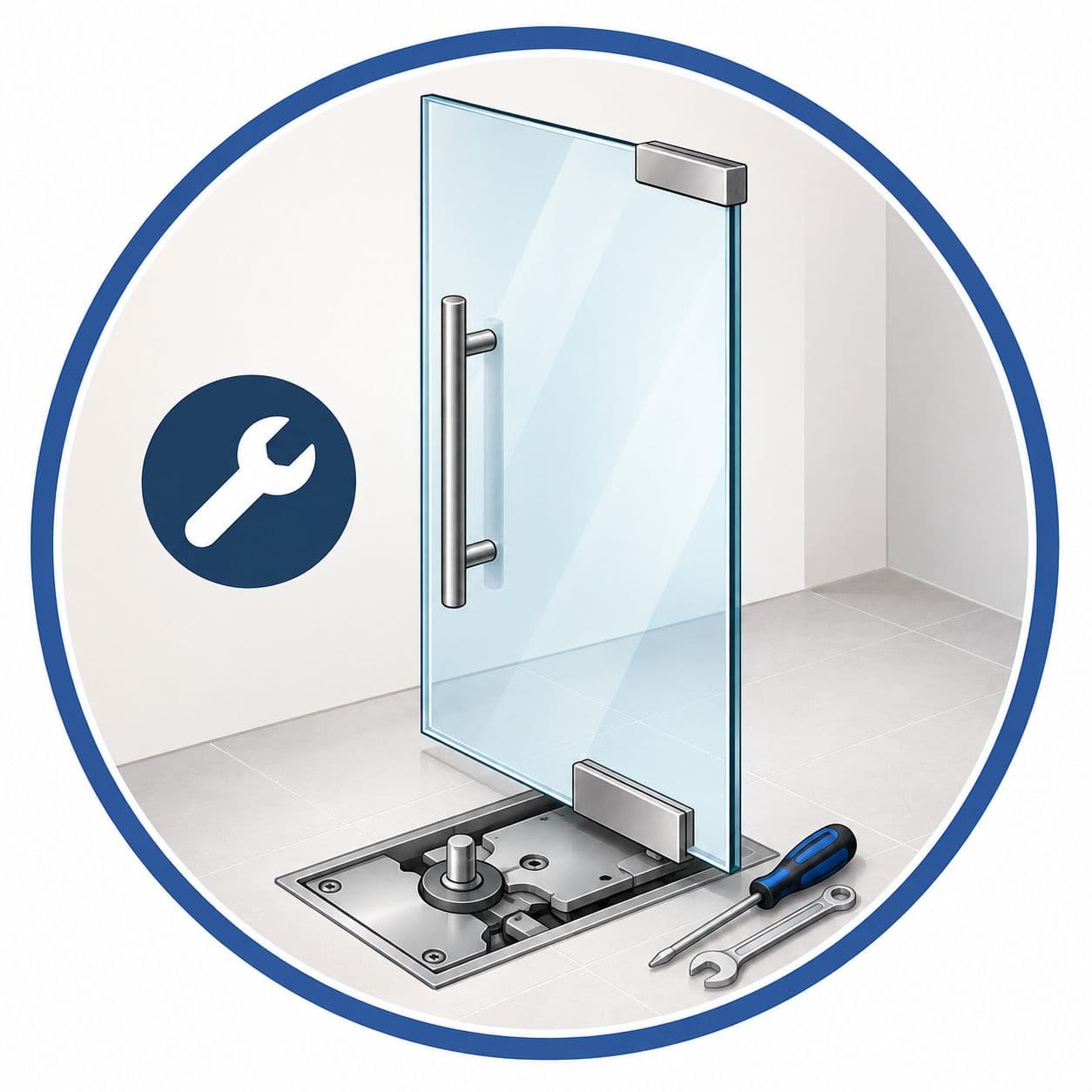
A floor spring is the right choice for a frameless toughened glass door: it sits in a pit under the door, carries the door's weight on a pivot and controls how it closes, with nothing visible on the glass except two small patch fittings. A door closer (the overhead hydraulic arm) suits a framed door of wood, aluminium or steel, where there is a solid frame head to screw it to. Office cabins and shop fronts in Gurugram and Noida almost always use floor springs; a framed cabin door or a fire-exit door usually takes a closer.
Locally, the floor spring is usually called the floor machine. Below: how both devices work, how to tell which one you have, and what each needs over its life.
How does a floor spring actually work?
A floor spring is a sealed steel box filled with hydraulic oil and a heavy spring. It is set into a recess cut in the floor, levelled, and covered with a stainless cover plate. A spindle sticks up from the box. The bottom of the glass door is held in a bottom patch (a clamp with a socket) that sits on that spindle, and the top of the door is held by a top patch with a pivot pin into the ceiling or transom. You can read more about those clamps under patch fittings.
When you push the door, the spring is compressed. When you let go, the spring pushes the door back, and the oil passing through small valves slows it down. Most floor springs have two adjusting screws: one for the closing speed over most of the swing and one for the latching speed over the last few degrees. Many also have a hold-open position at about 90 degrees, and most are double-action, so the door swings both in and out.
And how does an overhead door closer work?
A hydraulic door closer uses the same idea, a spring damped by oil, but packed into a body that is screwed to the face of the door near the top, with an arm linking it to the frame. It does not carry the door's weight. The hinges do that. The closer only pulls it shut at a controlled speed.
That difference is the whole story. A closer needs hinges and a frame. A 12mm frameless glass door has neither, so it needs a device that is both the hinge and the closer at once: the floor spring.
| Point | Floor spring (floor machine) | Overhead door closer |
|---|---|---|
| Where it sits | In a pit in the floor, under the door | On the door face or frame head, at the top |
| Carries the door weight? | Yes, on its spindle | No, the hinges do |
| Best suited to | Frameless toughened glass doors, shop fronts, office cabins | Framed doors: wood, aluminium profile, steel, fire exits |
| Swing | Usually double-action (both ways) | Usually single-action (one way) |
| Visible hardware | Only the floor cover plate and patch fittings | Body and arm at the top of the door |
| Fitting work | Cutting a floor pit, levelling, fixing the top pivot | Screwing to door and frame |
| Typical faults | Oil leak, door dropping, closing too fast, not centring | Oil leak, arm loose, slamming, not latching |
Which one does a frameless glass door need?
For a frameless glass door, nearly always the floor spring. A full-height frameless glass cabin with a door or a toughened glass shop front with a door is too heavy to hang on clamp hinges from a glass side panel when it is used dozens of times an hour, and there is no frame for a closer to sit on. The floor spring takes the weight straight to the slab.
There are other ways to hang frameless glass: glass-to-glass hinges, wall-mounted hinges with a built-in closing action, and pivot hinges. These are common on shower doors and light internal doors, where the glass is thinner and traffic is lower. For a busy office or shop door they tend to sag and loosen sooner than a floor spring.
When an overhead closer is the better answer
- An aluminium-framed office cabin door or a timber door, where the frame head can take the closer's screws.
- A floor that cannot be cut: a raised access floor, under-floor services, or a finished floor the owner won't open up.
- A fire-exit or back-of-house door that should only open one way.
- A low-traffic internal door where a hidden floor pit isn't worth the work.
What does each one need to keep working?
Both are hydraulic, both have seals, and both eventually lose oil. What shortens their life is the same short list: a door pushed past its stop, a door heavier or wider than the unit was meant for, and dirt or water getting in. Once a month, open the door fully and let go: it should slow evenly, then latch gently without a bang.
A floor spring in a shop entrance gets wet every time the floor is mopped, and wet-mopping straight into the cover plate gap is one of the commonest reasons for a rusted spindle. Our glass door maintenance checklist has the full routine for doors, patches and handles.
What goes wrong with each, and can it be fixed?
Floor spring faults
- Leaking oil: the seals have gone. Once a floor spring loses oil it cannot control the door, so the unit is normally replaced, not refilled. See floor spring leaking oil.
- Door closing too fast or slamming: often a valve that needs adjusting, sometimes a failing unit. See glass door closing too fast.
- Door not closing fully or not centring: valve setting, a worn spindle, or a top pivot that has moved. See glass door not closing.
- Door dropped and scraping the floor: usually the bottom patch has slipped or the box has sunk. See glass door dropped and dragging.
Door closer faults
- Oil running down the door: a failed seal; the closer is replaced. See door closer leaking oil.
- Slamming or not latching: valve adjustment, or a closer too small for the door.
- Arm loose or bracket pulling out: the screws have worked loose in a soft frame.
For a glass door on a floor spring, the repair is the glass door floor machine repair service: the old unit comes out, a new one is set into the pit and levelled, the patches are re-fitted, and the speeds are set. If you want the detail on how an office replacement runs, see our guide to office door machine replacement in Gurugram.
Does a floor spring cost more than a door closer?
Usually, yes: it is heavier hardware, it needs a floor pit, careful levelling and top and bottom patches, while a closer simply screws to an existing frame. But a frameless glass door can't use a closer in the normal way, so for glass the real choice is which floor spring, not floor spring or closer.
On our glass styles the floor machine is part of the job. Frameless and aluminium-framed office cabins start from ₹400 per sq ft and ₹1,100 per sq ft respectively, and each lists a 2 year functional warranty on the floor machine. The glass door installation cost guide explains what else moves the price of a glass door.
How do you know which one your door has?
- Look at the floor under the hinge side of the door. A rectangular steel plate set flush in the floor means a floor spring.
- Look at the top of the door. A metal body with a folding arm to the frame is an overhead closer.
- Look at the bottom corner of the glass. A metal clamp that holds the glass and sits over the floor plate is the bottom patch of a floor spring.
- Push the door both ways. If it swings in and out and comes back to centre, it is almost certainly on a floor spring.
Floor-spring doors are standard in commercial buildings from Cyber City and Udyog Vihar to the IT offices around Sector 62 in Noida, and in shop fronts across Delhi and Faridabad. If you run an office, our glass work for offices page shows the cabin and door styles side by side.
If your door is already misbehaving, you don't need a paid visit to find out which device it has: send a short video of the door opening and closing, and a photo of the floor plate, on WhatsApp, and the repair is quoted from that.
Common questions
Is a floor spring better than a door closer?
For a frameless glass door, yes, because a floor spring carries the door's weight and controls closing in one hidden unit. For a framed wooden or aluminium door, an overhead closer is simpler and works well. Neither is better in general; the right one depends on whether the door has a frame and whether the floor can be cut.
Can a floor spring be repaired or does it need replacing?
Speed problems can often be fixed by adjusting the closing and latching valves, and a dropped door is often a bottom patch that has slipped. Once a floor spring is leaking oil, though, the seals have failed and the unit is normally replaced rather than refilled. Send a video on WhatsApp and the repair is quoted from it.
Can I fit a door closer on a frameless glass door?
Not a normal overhead closer, because there is no frame to screw it to and the glass can't be drilled for it after toughening. Some specialised glass-mounted closers and closing hinges exist for light doors, but busy office and shop doors generally use a floor spring.
Floor machine kharab hai, kaise pata chalega?
The usual signs are an oily patch around the steel plate in the floor, a door that slams or drifts open, a door that no longer stops in the centre, or a door that has dropped and scrapes the floor. Any one of these means the floor machine needs checking. A short video on WhatsApp is enough for a repair quote.
Does FabWise give a warranty on the floor machine?
On the office glass styles that list it, yes: the frameless glass cabin, the fixed frameless glass wall and the aluminium-framed cabin each carry a 2 year functional warranty on the floor machine. Our warranty is on fittings, not on the glass itself.
What this page is about
Read next
- Why Does Toughened Glass Break on Its Own? Causes, Signs and What to DoToughened glass is strong, but it isn't unbreakable, and it can shatter with nobody touching it. The real causes, the warning signs, and what to do when a shower door or cabin panel goes.
- Glass Door Maintenance Checklist: Weekly, Monthly and Yearly CareFive minutes a month keeps a glass door from sagging, slamming or breaking. A checklist for shower doors at home and cabin and shop doors at work, plus the signs that need a repair.
- Glass Door & Partition Repair in Gurugram & NoidaDamaged doors, cracked panes and partition repairs, assessed from a photo and quoted without a paid site visit.