

Hardware glossary · Gurgaon & Noida
What is a hydraulic door closer?
A hydraulic door closer is the box-and-arm device at the top of many doors. Opening the door compresses a spring; as it swings back, oil is forced through small valves so it closes steadily without slamming. It suits framed wooden, metal and aluminium doors; heavy frameless glass doors use a floor spring instead.
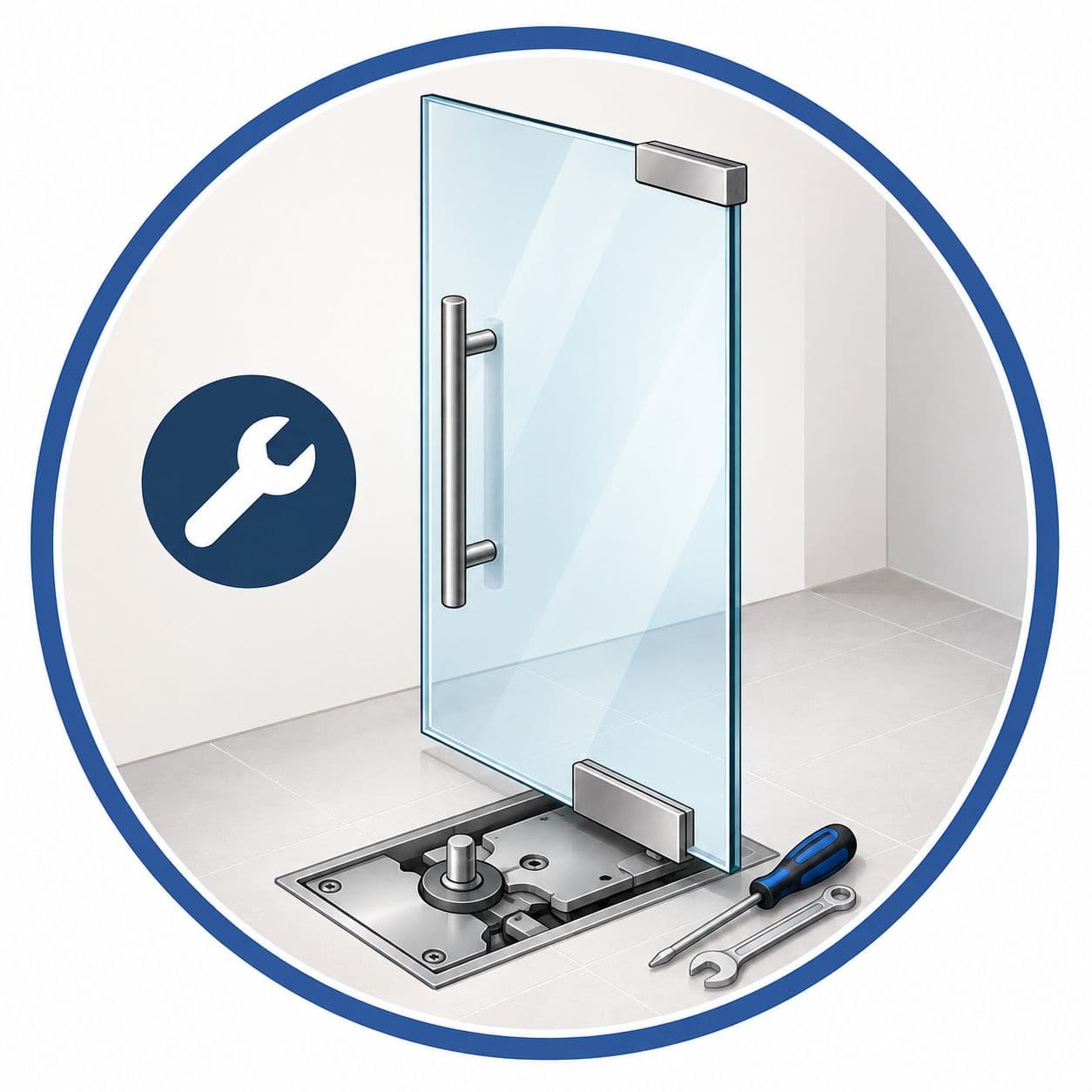
How does it work?
Inside the closer body is a steel spring and a piston in an oil-filled cylinder. When the door opens, a rack-and-pinion or cam mechanism turns the arm and compresses the spring. When you let go, the spring drives the piston back, and the oil it displaces has to pass through small channels whose size is set by adjustment screws. That restriction is what slows the door. The same principle, packed into a box under the floor, is a floor spring.
Types of overhead closer
| Type | How it's fitted | Notes |
|---|---|---|
| Standard (scissor) arm | Body on the door, arm to the frame, on the pull side | Strongest and cheapest; arm sticks out from the door |
| Parallel arm | Body on the push side, arm parallel to the door | Used where a closer on the pull side would be in the way |
| Slide channel (slide arm) | Arm runs in a track instead of folding out | Neater look; usually slightly less closing efficiency |
| Concealed / transom closer | Hidden in the door head or the frame above | Clean look; installation built into the door or frame |
| Glass door top closer | Mounted on a top patch or transom on glass doors | For lighter glass doors where a floor can't be cut |
What can be adjusted?
- Closing speed and latching speed, the final few degrees, via two valves.
- Back-check, which cushions the door near full opening so it doesn't hit the wall.
- Delayed action on some models, holding the door briefly before it starts closing, useful for trolleys.
- Spring power on adjustable-size closers, which sets how hard it pulls the door shut.
- Hold-open on certain arms, though a held-open fire door defeats its purpose.
How are closers sized?
Closing force is graded under the European standard EN 1154 into numbered power sizes, chosen from the door's width, weight and conditions such as wind on an external door. Too weak and the door won't latch; too strong and it is hard to open, especially for children or the elderly. Adjustable-power closers cover a range of sizes.
Where is it used, and where isn't it ideal?
- Framed doors: wooden flush doors in offices, aluminium or uPVC entrance doors, metal and MS safety doors.
- Fire doors and stairwell doors, where self-closing is a requirement.
- Aluminium-framed glass doors in partitions where the frame can take the fixing.
For heavy 12mm frameless glass doors, an overhead closer is usually the wrong tool: the glass can't take screws, the door's weight still has to be carried by something, and the closer would be visible on clear glass. A floor spring with patch fittings carries and closes the door from below. The trade-offs are compared in floor spring vs door closer.
Signs it's failing
- Oil on the body or dripping down the door: seals have gone. See door closer leaking oil.
- Door slams even after slowing the valves: the hydraulics have failed.
- Door doesn't latch: spring power too low, latching speed mis-set, or the door has dropped on its hinges.
- Arm loose or rattling: fixing screws pulled out of the frame or door.
Common confusions
- Door closer vs floor spring: same idea, different place. The floor spring also carries the door's weight.
- Door closer vs door stopper: a stopper only limits how far a door opens.
- Hydraulic vs pneumatic: cheaper screen-door closers use air, not oil, and give much less control.
Care
Adjust valves by small fractions of a turn; turning a valve right out can let oil escape. Don't force the door past its opening limit or prop it against the closing force for long periods. Check the fixing screws once or twice a year, especially on heavy doors. A leaking closer can't be topped up; it is replaced.
Door closers and FabWise
FabWise hangs its frameless glass cabin and shopfront doors on floor springs rather than overhead closers. Closers come into framed doors such as aluminium, uPVC and metal doors in the windows and doors and metal fabrication families in Gurugram and Noida, quoted after a site visit. Problems with an existing glass door closer start with a photo on WhatsApp under glass door floor machine repair.
Common questions
What is the difference between a door closer and a floor spring?
Both use a spring and oil to close a door at a controlled speed. A door closer is mounted on the top of the door or frame and the hinges carry the door's weight. A floor spring sits hidden in the floor and also acts as the door's bottom pivot, carrying its weight, which is why it is used for heavy frameless glass doors.
How do I stop my door closer from slamming?
Find the two adjustment screws on the closer body, one for closing speed and one for latching speed, and turn the relevant one clockwise by a small fraction of a turn, testing as you go. If the door still slams with the valves turned in, or there is oil on the body, the hydraulics have failed and the closer needs replacing.
Door closer se oil leak ho raha hai, theek ho sakta hai?
Usually not. Oil leaking from a hydraulic door closer means the internal seals have failed, and the unit can't be refilled reliably. It will gradually lose control and the door will start slamming. The practical fix is a replacement closer of the right size for the door, fitted to the existing holes where possible.
Can a door closer be fitted to a glass door?
On an aluminium-framed glass door, yes: the closer fixes to the frame. On a frameless toughened glass door, a standard closer can't be screwed to the glass. Special top closers mounted on patch fittings exist for lighter glass doors, but heavy 12mm frameless doors are normally hung on a floor spring instead.
Services on this page
Related terms
- Aluminium sectionsAluminium sections are extruded aluminium alloy profiles, most often alloy 6063 in a T5 or T6 temper, that form the frames of windows, sliding doors, partitions, louvres and facades, finished by anodising or powder coating.
- Double-glazed unit (DGU)A double-glazed unit (DGU, or insulated glass unit) is two panes of glass held apart by a spacer and sealed around the edge, with dry air or gas trapped between them to cut heat and noise.
- EPDM gasketsEPDM gaskets are flexible synthetic-rubber seals, made from ethylene propylene diene monomer, used in windows, doors, facades and glass systems because they stay elastic and resist sun, ozone and weather far longer than PVC seals.
- Low-E glassLow-E (low-emissivity) glass carries a microscopically thin metallic coating that reflects heat radiation while letting most visible light through, improving a window's insulation.
- Pleated mosquito meshA pleated mosquito mesh is an insect screen whose mesh is folded like an accordion and slides sideways in a slim aluminium frame, so it folds away when open and stays in place wherever it is left, without springs or a roller.
- uPVC profilesuPVC profiles are the hollow, multi-chambered frame sections of unplasticised polyvinyl chloride, stiffened inside with galvanised steel, that window and door frames are built from; they insulate well, need no painting and seal tightly.