

Glass glossary · Gurgaon & Noida
What is fluted glass?
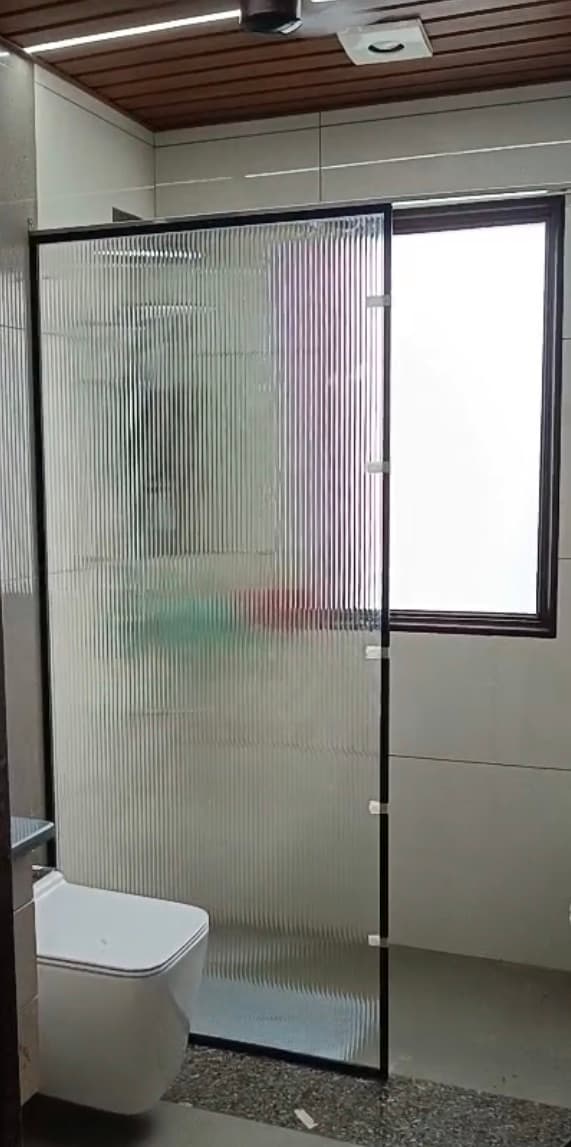
Fluted glass is glass with a row of parallel vertical ribs or grooves on one face. The ribs bend light so shapes behind it become soft vertical blurs: you get privacy and daylight at once. It is popular for shower partitions, cabin walls and wardrobe shutters, and it can be toughened like clear glass.
How is fluted glass made?
Fluted glass belongs to the family of patterned (figured) glass. Instead of being floated flat on molten tin like clear glass, the hot ribbon is passed between rollers, one of which is engraved with the rib pattern. The pattern is pressed into one face; the other face is usually flat. Rib width varies by product, from fine lines a few millimetres apart to broad, chunky flutes.
The pattern is part of the glass, not a coating or film, so it doesn't peel or fade. Like clear glass, the sheet can then be cut, edge-polished, drilled and toughened for use in doors and showers.
Fluted, reeded, ribbed: are they different?
Strictly, flutes are concave channels and reeds are convex, rounded ridges. In practice, and in most Indian showrooms, "fluted", "reeded" and "ribbed" glass are used interchangeably for any glass with vertical lines. What matters when choosing is the rib width (fine ribs read as a soft texture, wide ones as a bold stripe), the depth of the pattern (deeper ribs hide more) and whether the glass is clear, bronze or grey.
How much privacy does it give?
| Glass | Seen through it | Light | Best for |
|---|---|---|---|
| Clear toughened | Everything | Full | Open-feel cabins, walk-in showers |
| Fluted / reeded | Colours and movement, no detail; clearest up close | High | Shower doors, cabin fronts, wardrobe shutters |
| Frosted glass | Shadows only | High, diffused | WCs, meeting rooms, full privacy |
| Back-painted glass | Nothing | None through it | Wall cladding, kitchen splashbacks |
Privacy through fluted glass changes with distance: an object pressed against the glass is still fairly recognisable, while someone a metre behind it becomes coloured stripes. For a bathroom on a shared wall, it gives a softer look than frosted glass but slightly less screening.
Where is it used, and where does it fall short?
- Shower partitions and doors, often in a slim-profile shower partition with door with matte black frames.
- Office cabin fronts and conference rooms where you want to see that the room is occupied but not read the screen; see office glass partition sound and privacy.
- Kitchen and wardrobe shutters, bar backs and display fronts.
It is less suited to a window you want to look out of, to a wall that needs complete visual privacy, or to a very hard-water bathroom if nobody will squeegee it, because water and soap residue collect in the grooves. Patterned glass is also usually available in a narrower range of thicknesses than clear float, so confirm the available thickness before designing a frameless door around it.
How do you identify it?
Run a finger across the face: one side has distinct ridges and the other is usually smooth. That is how to tell it from a fluted film stuck to clear glass, where the edge of the film is visible and the texture is soft plastic. A stamp in the corner tells you whether the fluted panel has been toughened.
Common confusions
- Fluted vs frosted: frosted glass is evenly matt all over; fluted is clear glass shaped into ribs. Fluted gives a crisper, more decorative effect.
- Fluted glass vs fluted film: film is cheaper and easy to change but scratches, lifts at edges and is not a safety measure. See frosted film vs frosted glass, the same argument applies.
- Fluted vs tinted: tinted glass changes colour, not texture. Fluted glass can be tinted too, in bronze or grey.
Which way should the ribs face, and how do you clean them?
Fitters commonly face the ribbed side away from the wet zone of a shower, so the side that gets splashed is the flat one and dries without leaving streaks in the grooves. On a cabin front the ribs often face the corridor for the look. Clean with a soft brush or microfibre cloth that can reach into the channels, and rinse off soap. For limescale, a mild acidic cleaner or diluted vinegar works better than scrubbing, and our guide to shower glass hard-water cleaning covers the routine.
Fluted glass at FabWise
FabWise's published bathroom styles are built with Saint-Gobain toughened glass, 10mm thick, with SS304 fittings, and the office cabins with 12mm. If you want fluted glass in place of clear, raise it at the site visit in Gurugram or Noida: availability in the thickness your design needs is confirmed before the quote. For ideas, see fluted glass shower partition ideas.
Common questions
Is fluted glass the same as reeded glass?
In everyday use, yes. Technically fluted glass has concave grooves and reeded glass has convex ridges, but most suppliers and designers in India use the two names, along with ribbed glass, for any glass with vertical lines. Compare samples of rib width and depth rather than relying on the name, because those decide the look and the privacy.
Can fluted glass be toughened for a shower door?
Yes. Fluted glass can be cut, drilled for hinges and then toughened, just like clear float glass, which is what a shower door requires. The limitation is usually thickness: patterned glass comes in fewer thicknesses, so check that the fluted glass you like is available in the thickness the door design needs before you fix the design.
Does fluted glass give full privacy in a bathroom?
Not complete privacy. It turns people and objects into blurred vertical stripes, and the effect gets stronger the further away they are, but colour and movement still show and anything close to the glass is easier to make out. For a WC or a bathroom on a shared wall where you want nothing visible, frosted or acid-etched glass hides more.
Fluted glass saaf karna mushkil hai kya?
It needs a little more care than flat glass because water, soap and limescale settle in the grooves. Use a soft brush or microfibre cloth that reaches into the ribs, rinse after cleaning, and squeegee the flat face after a shower. Placing the ribbed face on the dry side of a shower partition makes daily upkeep much easier.
Services on this page
Related terms
- Glass thickness guideA glass thickness guide matches common glass thicknesses, from 4mm to 12mm and laminated build-ups, to the uses each one typically suits, based on span, support and safety.
- Glass-to-glass hingeA glass-to-glass hinge is a hinge that clamps two glass panels together so a glass door can swing directly off a fixed glass panel, used mainly in frameless shower enclosures.
- ACP fire-retardant (FR) coreAn FR-core ACP is an aluminium composite panel whose core between the two aluminium skins is heavily filled with mineral fire retardants instead of plain polyethylene, so it resists ignition and flame spread far better than a standard PE-core panel.
- Aluminium sectionsAluminium sections are extruded aluminium alloy profiles, most often alloy 6063 in a T5 or T6 temper, that form the frames of windows, sliding doors, partitions, louvres and facades, finished by anodising or powder coating.
- Back-painted glassBack-painted (lacquered) glass is glass with an opaque coloured coating applied to its rear face, so the colour is seen through a glossy glass surface; it is used for wall cladding, splashbacks and writing boards.
- CNC laser-cut jaaliA CNC laser-cut jaali is a decorative perforated screen cut from metal sheet, usually mild steel, stainless steel or aluminium, by a computer-controlled laser that follows a digital pattern, used in gates, partitions, grills, facades and railings.