

Glossary · Glass railings · Gurgaon & Noida
Glass railing spigots: point-fixed frameless glass
Glass railing spigots are compact stainless steel posts that grip the bottom edge of each glass panel, usually two per panel. They are bolted to the floor with a base plate or set into core-drilled holes, giving a near-frameless railing with small gaps between panels and no continuous channel along the floor.
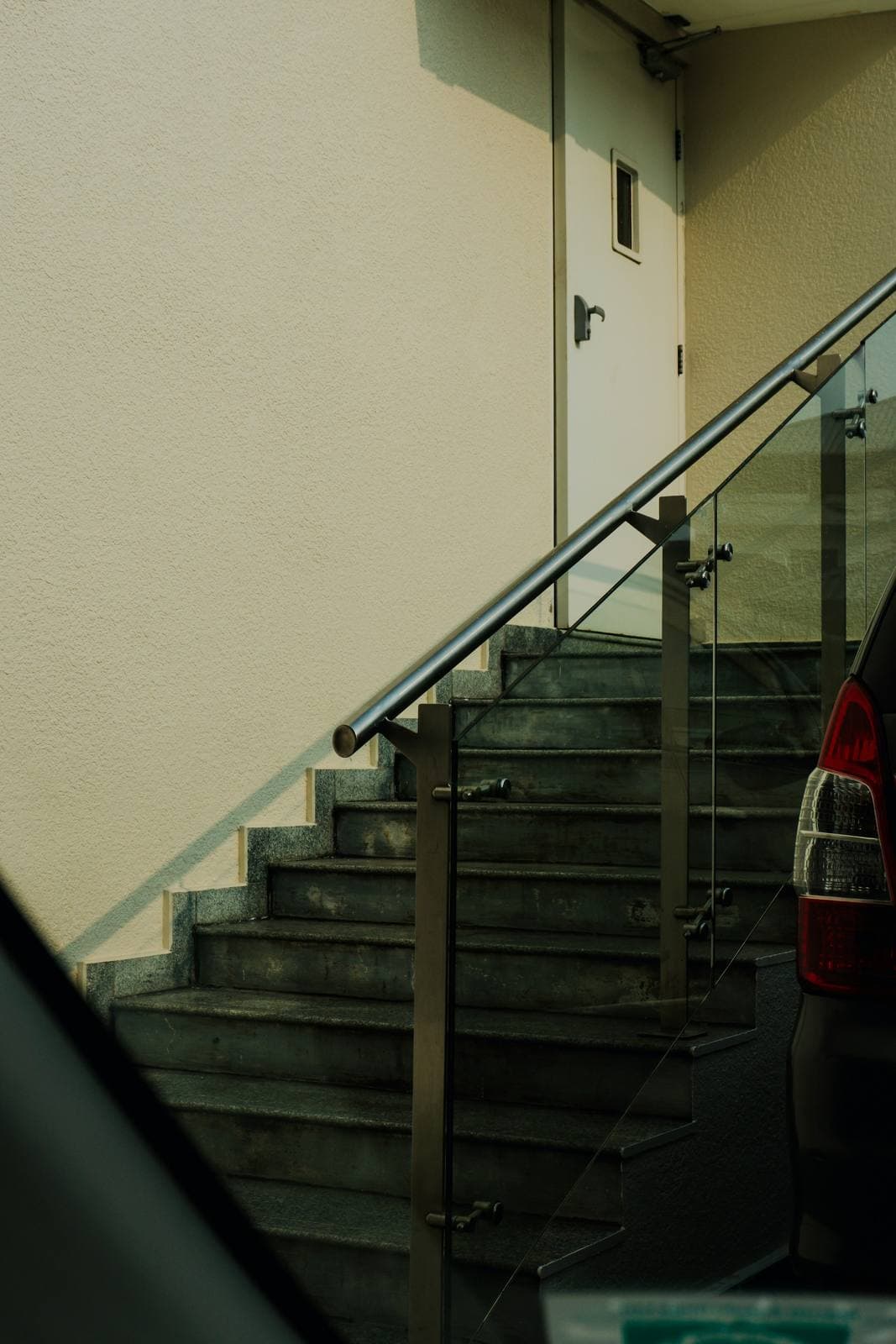
If you have seen a glass pool fence or a stair railing where each panel seems to stand on two short steel stubs, those stubs are spigots. They sit between a fully frameless U-channel and a traditional post-and-clamp railing: lighter on the eye than posts, simpler to install on many floors than a base channel. In Gurugram and Noida homes they are common on internal staircases, duplex landings and terrace edges.
How do spigots hold the glass?
A spigot is a short, solid or thick-walled stainless steel post, round or square, with a slot or clamp at the top. The glass sits in the slot on rubber or plastic inserts and is locked with grub screws or a clamping plate, so steel never touches glass directly. Each panel usually has at least two spigots, positioned in from the panel ends according to the maker's tables. There are two main fixing types:
| Base-plate spigot | Core-drilled spigot | |
|---|---|---|
| How fixed | Plate bolted to the slab with anchors, often hidden by a cover | Spigot set into a hole drilled in the concrete and grouted or resin-fixed |
| Look | Small square or round plate at floor level | Cleanest; spigot rises straight from the floor |
| Floor finish | Can go on finished tiles or stone | Usually set before or through the finish |
| Adjustability | Easier to level with shims | Fixed once set |
| Waterproofing | Anchors penetrate the slab | Larger holes must be sealed well |
| Typical use | Retrofits, balconies, stairs | Pool fences, new builds, landscaped decks |
Spigots vs U-channel vs posts
A glass railing U-channel gives a continuous base with no gaps between panels and can be very clean, but it needs a long, strong edge and a deeper recess or a visible channel. Spigots concentrate load at a few points, so they suit stairs with changing levels and decks where a continuous channel would trap water. Posts with glass clamps are the most forgiving structurally and allow thinner glass, but they are the most visible. Our glass balcony railing guide walks through choosing between them.
What glass and steel do spigots need?
- Glass: toughened glass, and often laminated glass at height or over a drop, in the thickness the spigot system is tested for. The panel's edges and corners are polished before toughening.
- Steel grade: stainless steel, commonly SS304 for interiors and covered areas, and SS316 near pools or in harsh exposure. See SS304 vs SS202 for why the cheaper grade stains outdoors.
- Handrail: a continuous top rail or side-mounted handrail adds safety and is often needed on stairs for grip.
Where spigots work best
- Internal and external staircases with a sloping line, where spigots follow each tread level.
- Terraces and roof decks where water must flow freely under the railing.
- Pool surrounds and garden edges.
- Duplex and mezzanine landings that need a light, open look.
They are less suited to thin or hollow slabs, cantilevered edges with doubtful concrete, or locations where very tall panels would put large leverage on each point.
How do you check a spigot railing?
- Ask for the spigot system, its steel grade and its tested glass thickness.
- Check anchor type and embedment, especially near a slab edge.
- Look for rubber inserts so glass never touches steel.
- Check that all spigots are plumb, panels are aligned and gaps are even.
- Push each panel near the top: there should be no movement at the spigots.
Common confusions
Spigots are not the same as spider fittings, which hold glass facades and canopies at drilled points, or patch fittings on glass doors. Standoff ("button") fittings on the face of the slab are yet another side-mounted system.
Care and common problems
Wipe spigots with a soft cloth and stainless steel cleaner; never use bleach or acid floor cleaners near the bases. Loose grub screws let panels creep; see glass railing panel loose. If the whole railing moves, the anchors are the issue; see railing wobbling.
Where FabWise uses it
Glass railings for balconies and stairs, including the staircase railing and glass balcony railing, are quoted after a site visit, where the floor and slab are checked to choose between spigots, a U-channel or posts. Browse the railings range.
Common questions
How many spigots does a glass panel need?
Usually at least two per panel, positioned according to the spigot maker's tables for the panel width, height and glass thickness. Wider or taller panels, or railings at greater heights, may need more or a thicker glass. Using fewer spigots than specified to save cost puts too much load on each fixing.
Are spigots or U-channel better for a glass staircase railing?
For most staircases, spigots are easier: they follow the changing height of the treads and do not need a continuous channel along the stair edge. A U-channel can be used along a straight stringer and gives a continuous base. The final choice depends on the stair structure and how the treads are finished.
Do glass railing spigots rust?
Quality spigots are stainless steel and should not rust in normal use, but lower grades can tea-stain, especially outdoors or near pools. SS316 is often specified for pools and harsh exposure, SS304 elsewhere. Bleach, acid cleaners and iron dust from nearby grinding also cause surface spots, which usually clean off early.
Spigot railing ke liye floor todna padta hai kya?
Not always. Base-plate spigots are bolted on top of the finished floor with anchors, so only small holes are drilled. Core-drilled spigots need larger holes into the concrete and are best planned before or during flooring. The slab thickness and any waterproofing below decide which is suitable.
Services on this page
Related terms
- Glass railing U-channelA glass railing U-channel (base shoe) is a continuous aluminium or steel channel fixed to the floor or slab edge that clamps the bottom of the glass panels, letting a balcony or stair railing stand without posts.
- Laminated glassLaminated glass is two or more glass panes permanently bonded with a plastic interlayer, usually PVB, so that the glass stays held together and in place when it breaks.
- SS304 vs SS202SS304 and SS202 are two austenitic stainless steel grades: SS304 carries about 18% chromium and 8% nickel and resists rust well outdoors, while SS202 swaps much of the nickel for manganese, costs less and stains sooner in damp or polluted air.
- ACP fire-retardant (FR) coreAn FR-core ACP is an aluminium composite panel whose core between the two aluminium skins is heavily filled with mineral fire retardants instead of plain polyethylene, so it resists ignition and flame spread far better than a standard PE-core panel.
- Aluminium sectionsAluminium sections are extruded aluminium alloy profiles, most often alloy 6063 in a T5 or T6 temper, that form the frames of windows, sliding doors, partitions, louvres and facades, finished by anodising or powder coating.
- Back-painted glassBack-painted (lacquered) glass is glass with an opaque coloured coating applied to its rear face, so the colour is seen through a glossy glass surface; it is used for wall cladding, splashbacks and writing boards.